Business News
India–EU FTA explained: What the ‘mother of all trade deals’ delivers
.png)
5 min read | Updated on January 28, 2026, 08:56 IST


SUMMARY
India and the European Union have concluded a landmark Free Trade Agreement (FTA), granting preferential market access to over 99% of Indian exports to the 27-nation bloc.
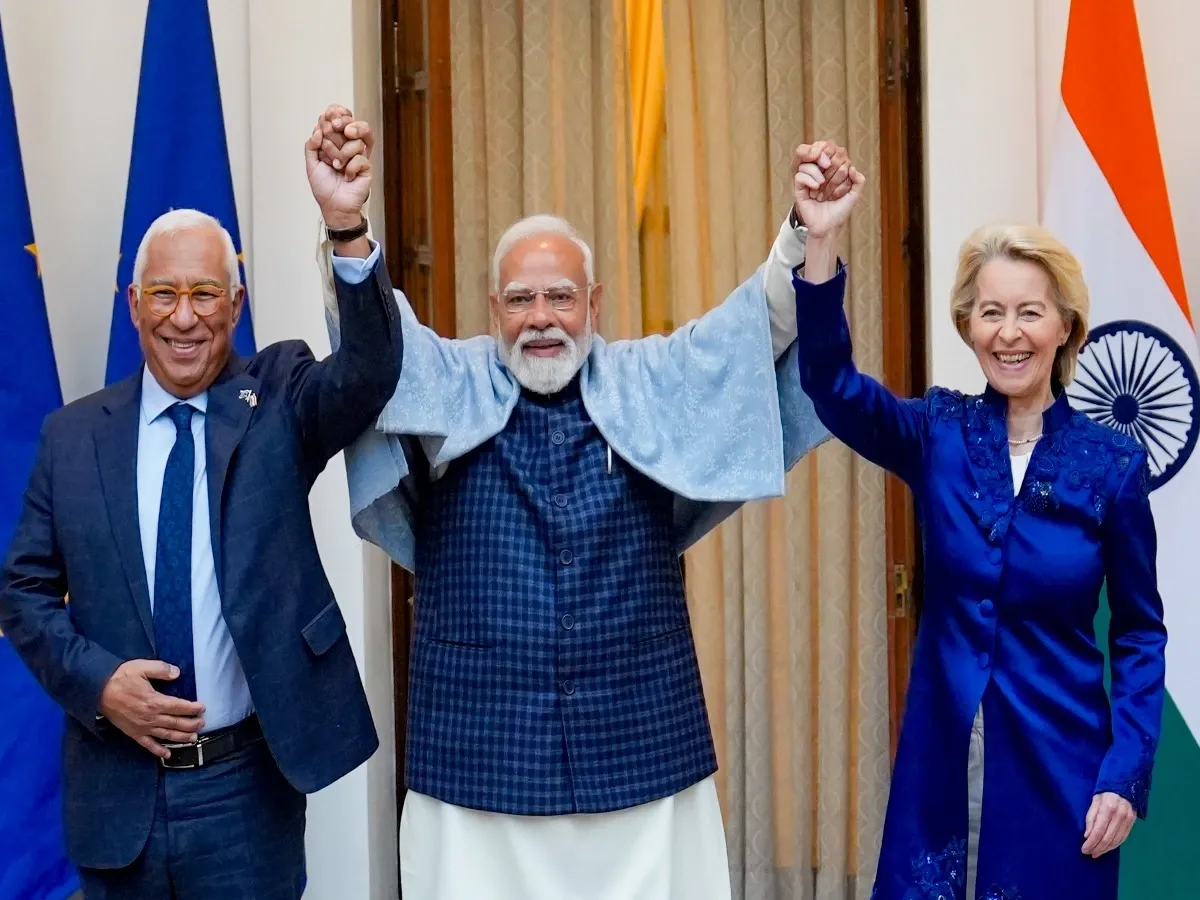
Prime Minister Narendra Modi with European Council President Antonio Costa, left, and European Commission President Ursula von der Leyen, right, during their meeting at the Hyderabad House, in New Delhi, Tuesday, Jan. 27, 2026. (PTI Photo)
India and the European Union on Tuesday concluded a long-awaited free trade agreement (FTA), opening preferential market access for over 99% of Indian exports to the 27-nation bloc.
The India–EU Free Trade Agreement (FTA) was jointly announced at the 16th India–EU Summit by Prime Minister Narendra Modi and European Commission President Ursula von der Leyen.
Addressing a joint press conference, PM Modi said the global order is in "great turmoil" and in such a context, the partnership between India and the EU will strengthen stability in the international system.
"This is not just a trade agreement. This is a new blueprint for shared prosperity," Modi said in his media statement.
The two sides also inked a strategic defence partnership pact and a mobility agreement.
Ursula von der Leyen said the India-EU partnership will send a strong message that cooperation is the best answer to global challenges.
“We have concluded the mother of all trade deals,” she posted on X.
The two sides also inked crucial pacts on security and defence collaboration and on the mobility of Indian talent to Europe.
The trade negotiations, which first began in 2007 but were paused six years later, were relaunched in 2022 amid concerns from their most sensitive sectors like agriculture and dairy.
The talks, however, gained urgency after US President Donald Trump upended the rules-based world order with his sweeping tariffs on trade partners.
While Indian goods were subjected to the steepest tariff of 50%, Europe faced the threat of higher tariffs despite reaching an agreement with the United States last year.
The unpredictability of Trump’s tariff era pushed both sides to meet at a common point in the trade deal.
Unprecedented access for Indian goods
Under the deal, the EU will eliminate or reduce tariffs on about 97% of its tariff lines, covering nearly 99.5% of India’s exports by value, according to the commerce ministry.
More than 70% of tariff lines, accounting for over 90% of India’s current exports, will see immediate duty-free access once the pact enters into force, benefiting labour-intensive sectors such as textiles, apparel, leather, footwear, gems and jewellery, marine products, toys and sports goods.
Exports worth nearly $75 billion are expected to benefit, with labour-intensive sectors such as textiles, apparel, leather, footwear, marine products, gems and jewellery gaining from tariff elimination of up to 10% on goods worth about $33 billion.
Another 20% of tariff lines will see duties phased out over three to five years, while a smaller share will receive partial tariff reductions or quota-based access.
The government said the FTA would create fresh opportunities for MSMEs and generate employment for women, artisans, youth and professionals by integrating Indian businesses deeper into global value chains.
India opens market gradually to EU goods
India, in turn, will offer tariff concessions on about 92% of its tariff lines, covering roughly 97.5% of EU exports.
Nearly half of these will see immediate tariff elimination, while others will be phased out over five to ten years. Sensitive agricultural sectors such as dairy, cereals, poultry and soymeal have been excluded to protect domestic producers.
Calibrated auto liberalisation
The pact provides for a carefully calibrated, quota-based liberalisation in the automobile sector.
While it allows European automakers to introduce models in higher price segments in India, it also opens the door for ‘Make in India’ manufacturing and future exports of India-made vehicles to the EU.
Sensitive sectors protected
Indian agricultural and processed food exports such as tea, coffee, spices, grapes, gherkins, vegetables and dried onion will receive preferential access to EU markets.
At the same time, India has fully safeguarded sensitive sectors including dairy, cereals and certain agricultural products.
Strong boost for services, mobility
The EU has committed market access across 144 services subsectors, including information technology, professional services, education and business services. India has made commitments in 102 subsectors covering EU priorities such as telecommunications, financial services, maritime and environmental services.
The pact also establishes a framework for the temporary movement of professionals, including business visitors, intra-corporate transferees, contractual service suppliers and independent professionals.
Indian IT professionals, engineers, consultants and researchers are expected to benefit from greater certainty and non-discriminatory treatment in the EU, while European firms gain clearer rules for investing and operating in India.
Trade and strategic impact
The EU, as a bloc, is India's largest trading partner in goods.
Bilateral goods trade between India and the EU stood at about $136.5 billion in 2024-25, while services trade reached $83 billion. Officials on both sides say current volumes fall short of potential given the size of their economies.
The deal comes as India accelerates its push to sign trade agreements with major partners and as the EU seeks reliable alternatives for sourcing amid geopolitical tensions and supply-chain disruptions.
The agreement is expected to come into force in 2027 after legal scrubbing and ratification by EU member states and the European Parliament.
Union Commerce and Industry Minister Piyush Goyal said the agreement goes beyond a conventional trade pact and represents one of India’s most consequential FTAs, supporting the ‘Make in India’ initiative and enhancing India’s global competitiveness.
The India–EU FTA becomes India’s 22nd free trade agreement and, along with recent pacts with the UK and EFTA, effectively opens up the wider European market for Indian exporters and investors.
The government said the agreement lays the foundation for inclusive, resilient and future-ready growth, aligned with India’s long-term vision of becoming a developed nation by 2047.
About The Author
Next Story