Business News
Budget Session 2026: President Droupadi Murmu maps India’s growth journey, backs ‘Reforms Express’
.png)
8 min read | Updated on January 28, 2026, 14:34 IST


SUMMARY
President Droupadi Murmu, addressing a joint sitting of Parliament at the start of the Budget Session, said India has entered a decisive phase in its development journey, with the past decade laying a strong foundation for achieving the goal of Viksit Bharat by 2047.
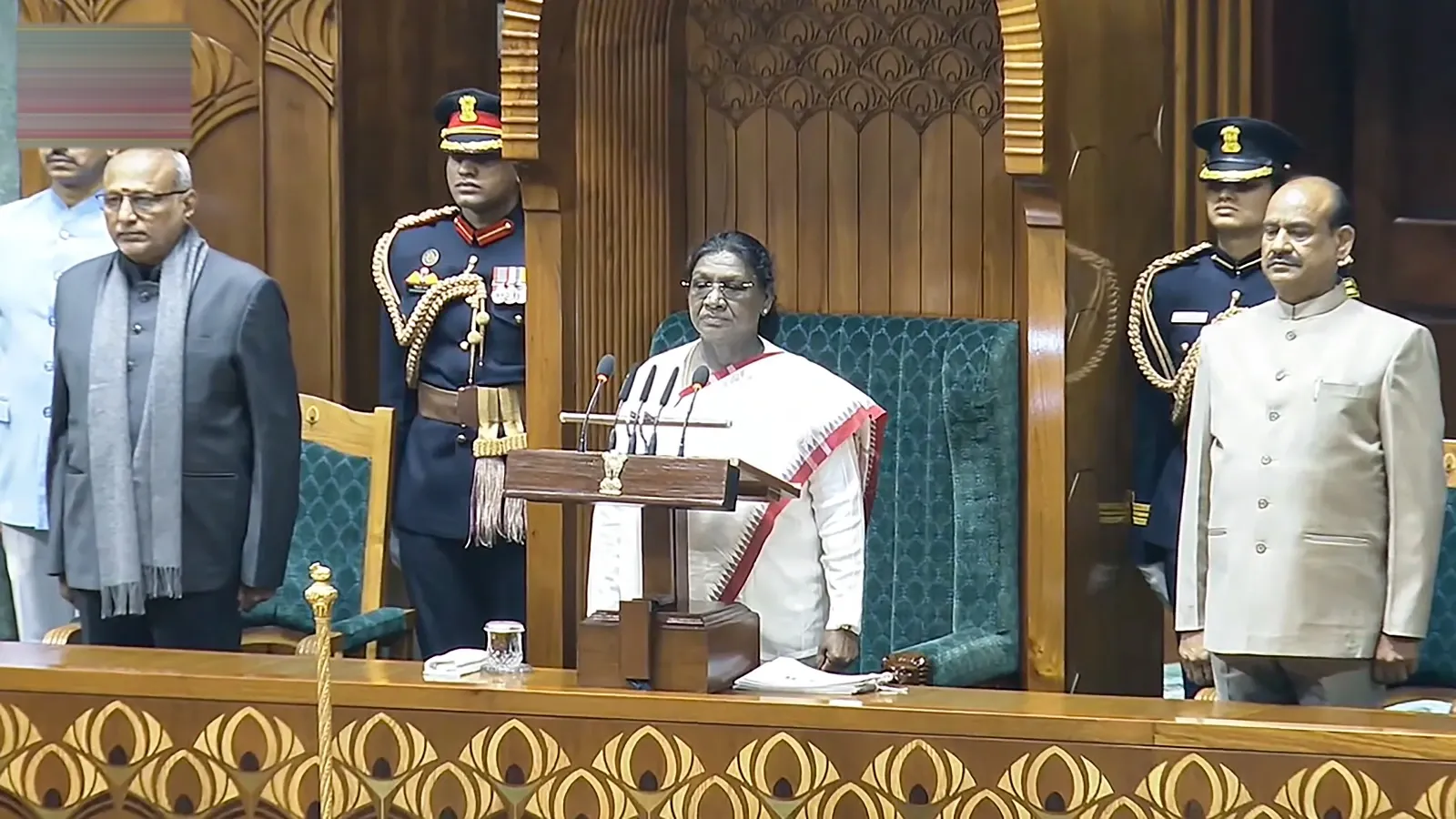
President Droupadi Murmu stands for the national anthem before her address during the joint sitting of both Houses of Parliament on the first day of the Budget session, in New Delhi, Wednesday, Jan. 28, 2026. (Sansad TV)
President Droupadi Murmu on Wednesday said India has entered a decisive phase of its growth journey and asserted that the past decade has laid a “strong cornerstone” for achieving the goal of a Viksit Bharat by 2047.
The President was addressing a joint sitting of Parliament to mark the beginning of the Budget Session.
“The completion of the first 25 years of this century has been marked by numerous successes, glorious achievements and extraordinary experiences,” Murmu said, adding that over the last 10–11 years, India has “strengthened its foundation in every sphere”.
The President arrived at Parliament in a ceremonial six horse-driven buggy and was welcomed by Vice President C P Radhakrishnan, Prime Minister Narendra Modi and Lok Sabha Speaker Om Birla.
She was escorted to the Lok Sabha chamber amid traditional ceremony, including a procession led by an official carrying the Sengol.
Social justice
Underscoring the government’s focus on inclusion, Murmu said social justice meant ensuring that “every citizen gets to exercise full rights, and without any discrimination”.
“As a result of this, 25 crore citizens have overcome poverty during the last decade,” she said.
The President said four crore pucca houses had been built for the poor in the last decade, while “possession of 32 lakh new houses has been given to the poor during the last year alone”.
She said the Jal Jeevan Mission had provided piped water to 12.5 crore households, Ujjwala Yojana had crossed 10 crore LPG connections, and over ₹6.75 lakh crore had been transferred directly to beneficiaries through DBT in the last year.
Health and social security
Murmu asserted that the government is working with full sensitivity for Dalits, backward classes, marginalised and tribal communities.
“At the beginning of 2014, social security schemes could reach only 25 crore citizens. Today, about 95 crore Indians have social security cover,” she said.
Under Ayushman Bharat, “more than 11 crore free medical treatments have been given”, while India had also achieved major public health milestones.
“It is a matter of pride that the World Health Organization has declared India free from the eye-disease trachoma,” she said.
Agriculture, farmers and food security
Calling farmers central to national progress, the President said, “For my government, a prosperous farmer is its first priority for Viksit Bharat.”
She said India had recorded a “record production of over 350 million tonnes of foodgrains”, become the world’s largest rice producer, and emerged as the second-largest fish producer globally.
Manufacturing, exports and economy
On the economy, Murmu said India had remained “the fastest growing major economy in the world” despite global crises, with better inflation control directly benefiting the poor and middle class.
“In a field like mobile manufacturing, India has now become the second-largest country in the world,” she said.
The President highlighted that smartphone exports had crossed ₹1 lakh crore in the first five months of 2025–26 and that India had begun exporting electric vehicles to over 100 countries.
She also welcomed the conclusion of negotiations on a free trade agreement with the European Union, saying it would “give impetus to the manufacturing and service sectors and create new employment opportunities for the youth”.
Infrastructure and connectivity
Murmu said India was making “unprecedented investment in modern infrastructure”, with progress across land, sea and air becoming “a topic of global discussion”.
She cited addition of about 18,000 km of rural roads in the past year, rapid railway electrification, expansion of Vande Bharat trains to over 150 services, and India crossing the 1,000-km mark in metro rail length.
“Now India has the third-largest metro network in the world,” she said.
Reforms, green growth and space
Referring to governance reforms, Murmu said PRAGATI meetings had accelerated projects worth over ₹85 lakh crore and strengthened the mantra of “Reform-Perform-Transform”.
On energy transition, she said nuclear power would play a key role in meeting future needs, and the recently enacted SHANTI Act would help achieve 100 GW of nuclear capacity by 2047.
“India will definitely achieve the target of 500 gigawatts of renewable energy capacity by the end of this decade,” she said.
The President also pointed to advances in space, saying, “Now, space tourism is also not beyond India’s reach,” and cited progress on the Gaganyaan mission and plans for an Indian space station.
Murmu said the government would continue to accelerate reforms and inclusive development, asserting that “the momentum of this Reforms Express will not slow down” as India advances towards becoming a developed nation.
VB-G RAM G Act
Murmu's reference to the VB-G RAM G Act in her address to the joint sitting of both houses of Parliament on Wednesday sparked protests from opposition parties which raised slogans demanding a roll back of the law.
The President said the Viksit Bharat - Guarantee for Rozgar and Ajeevika Mission (Gramin) (VB-G RAM G) would provide guarantee for 125 days of work, and would also stop corruption and leakages.
She also asserted that it would provide a new impetus to rural development.
While the President's mention of the VB-G RAM G Act was welcomed by treasury benches by thumping of desks, Opposition members raised slogans demanding roll back of the law.
The Act is set to replace the Mahatma Gandhi National Rural Employment Guarantee Act (MGNREGA).
Women-led development
Stressing that development was not possible without equal opportunity, Murmu said India was moving ahead with the mantra of “women-led development”.
“From Pradhan Mantri Awas Yojana to Jal Jeevan Mission, women beneficiaries have been given high priority in every scheme,” she said.
She said 10 crore women had been connected to self-help groups, while the number of Lakhpati Didi had crossed two crore.
“In the past year alone, over 60 lakh women have become Lakhpati Didi,” she said, adding that the government was close to achieving the target of empowering three crore women.
Murmu said the Namo Drone Didi initiative had emerged as a symbol of change in far-flung regions, with trained women using drones to transform agriculture.
She said health check-ups of about seven crore women had been conducted under the Swasth Nari, Sashakt Parivar campaign launched in September 2025.
Murmu also noted that the first batch of women cadets had graduated from the National Defence Academy, strengthening the belief that “Nari Shakti stands at the forefront of the nation’s development”.
Terrorism, Maoism and security
On national security, the President said India had shown that “power can be used with responsibility and prudence”. Referring to Operation Sindoor, she said India had destroyed terrorist base camps using its own resources and sent a clear message that “any terrorist attack on India will receive a firm and decisive response”.
“The suspension of the Indus Water Treaty is also a part of India’s fight against terrorism,” she said.
Murmu said decisive action against Maoist extremism had reduced affected districts from 126 to just eight, with only three remaining the most impacted. “During the last one year, nearly two thousand individuals associated with Maoism have surrendered,” she said.
She cited transformation in affected regions, noting that a bus reaching a village in Bijapur after 25 years was celebrated “like a festival”.
Make in India
Murmu said products made under Make in India were reaching global markets, with growing enthusiasm for Swadeshi.
Under the production-linked incentive scheme, she said investments of about ₹2 lakh crore had been attracted, with production exceeding ₹17 lakh crore. Electronics production has increased six-fold in 11 years to ₹11 lakh crore.
She said defence production had crossed ₹1.5 lakh crore in 2025, while defence exports touched a record ₹23,000 crore.
“After Operation Sindoor, confidence in Made-in-India defence platforms has grown stronger,” she said.
Murmu said India had received about USD 750 billion in foreign direct investment over the past 11 years and was pushing self-reliance in semiconductors, with four more chip manufacturing units sanctioned in 2025 and a total of 10 units set to begin operations soon.
She said the National Critical Mineral Mission was reducing dependence on imports of essential minerals, while a ₹70,000-crore package had been announced for the shipping sector to reduce reliance on foreign vessels.
Youth, startups and skills
Calling youth the driving force of national aspirations, Murmu said over 25 lakh jobs had been created in electronics manufacturing alone in the last 11 years, with new opportunities emerging in semiconductors, green energy and green hydrogen.
She said more than ₹38 lakh crore had been disbursed under the Mudra Yojana, with 12 crore loans given for first-time self-employment, while 72 lakh street vendors had received support under PM SVANidhi.
Noting that Startup India had completed 10 years, Murmu said India was now the world’s third-largest startup ecosystem, with nearly two lakh registered startups and over 20 lakh youth employed. She said 45 per cent of startups have at least one woman director.
Foreign policy and culture
On the global stage, Murmu said India was acting as a bridge amid global conflicts, amplifying the voice of the Global South and strengthening platforms such as G20, BRICS, BIMSTEC and SCO.
She said India would host a Global AI Impact Summit and currently holds the BRICS presidency.
The President said India was reclaiming its heritage, citing the return of Buddha relics, digitisation of ancient manuscripts under the Gyan Bharatam Mission, and UNESCO recognition of Diwali as Intangible Cultural Heritage.
Murmu urged MPs to rise above differences on issues of national interest, saying the resolve of Viksit Bharat, national security and self-reliance must unite Parliament.
“The goal of Viksit Bharat is not limited to any one government or one generation,” she said.
About The Author
Next Story