
Business News
Delhi HC upholds Centre's temporary Telegram ban ahead of NEET-UG re-test
3 min read | Updated on June 19, 2026, 11:45 IST


SUMMARY
Rejecting Telegram's challenge to the blocking orders, the court said the authorities acted on relevant material and recorded reasons for the decision.
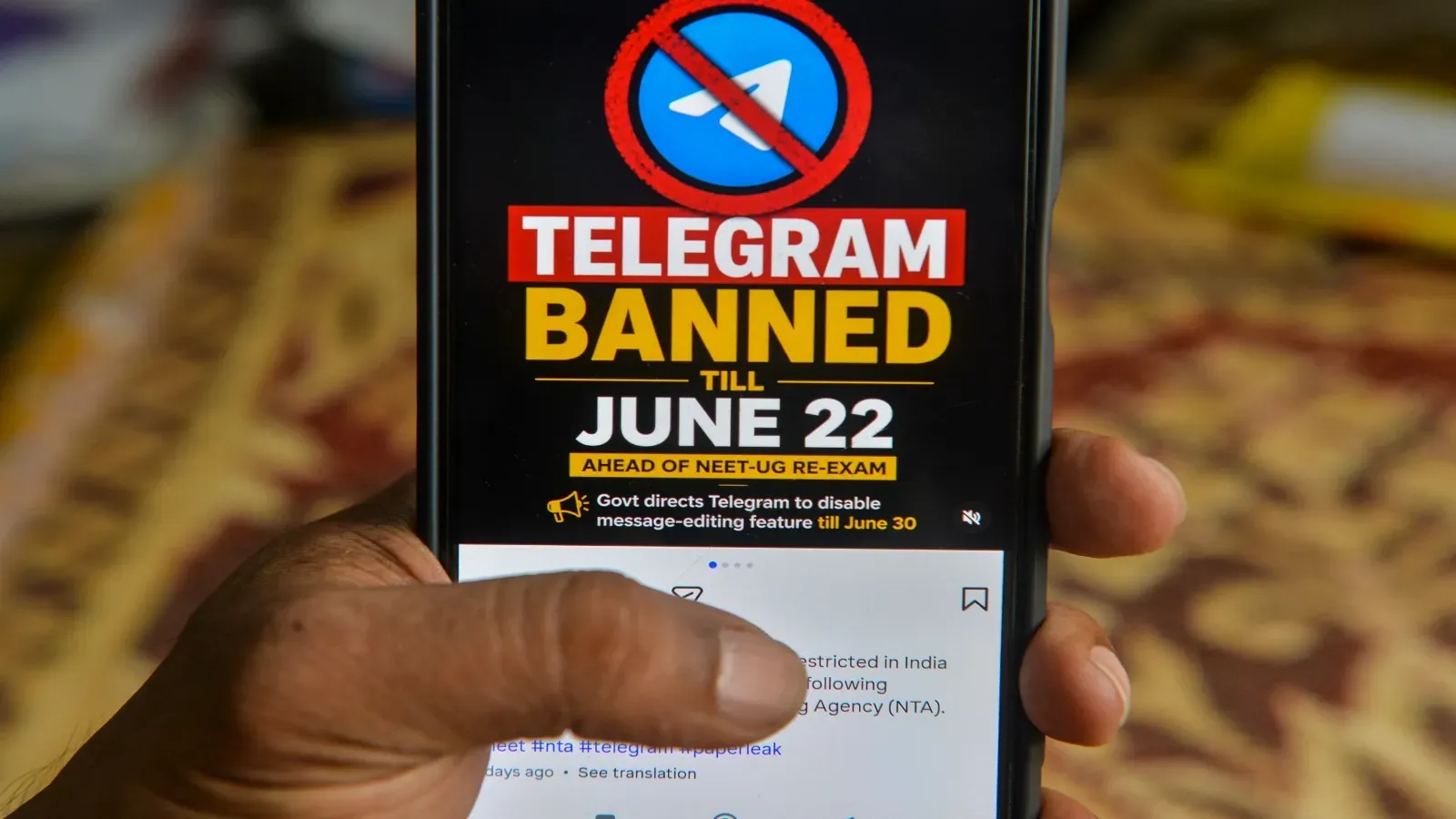
A man checks his mobile phone displaying information related to the temporary restriction on the messaging application Telegram ahead of the NEET-UG re-examination, in Siliguri, West Bengal, Thursday, June 18, 2026. (PTI Photo)
The Delhi High Court on Friday upheld the Centre's temporary ban on messaging platform Telegram imposed ahead of the June 21 NEET-UG re-examination, saying the government had followed the prescribed procedure given the emergency nature of the situation.
In its judgment, the court rejected Telegram's challenge to the blocking orders and held that the authorities had acted on relevant material and recorded reasons for their decision.
"After considering all arguments, we find that given the emergency nature of the impugned orders, the respondent strictly followed the procedure," the court said.
The ruling came on a plea filed by Telegram against the Centre's decision to temporarily restrict access to the platform till June 22, citing concerns that it could be misused during the NEET-UG 2026 re-examination.
The NEET-UG 2026 re-examination will be conducted on June 21.
A vacation bench headed by Justice Tejas Karia had reserved its verdict on Thursday after hearing senior advocate Dhruv Mehta for Telegram and Attorney General R Venkataramani and Solicitor General Tushar Mehta for the Centre.
During the hearing, the high court had questioned how the rights of around 150 million Telegram users could be curtailed because a section of users appearing for an examination might misuse the platform.
"How can we stop the rights of 150 million people just because one set of citizens are appearing in examinations?" the bench had asked.
The Centre vehemently argued before the high court that Telegram has all the potential of getting misused by miscreants.
Solicitor General Tushar Mehta, who represented the Centre, referred to the technical aspects of the messaging app and said that a single Telegram account can create up to 40 bots.
“I will just give an example. In Telegram, one account user can create 40 bots. While in case of WhatsApp, it's one bot per user. They have multiplicity encouraging architecture and then the bots can further multiply,” he said.
"Bots are machines; they can further multiply. As per the report, Telegram can offer bot infrastructure which can disseminate information in bulk. This feature is unique as it permits creation of sophisticated networks with minimal human oversight," the law officer said.
The solicitor general said the government does not have this problem with other intermediaries.
"This platform operates through the cloud. Even if they block it and someone does mischief, law enforcement agencies cannot reach the actual user," he said.
Mehta also mentioned that the report indicated that Telegram is frequently used for terrorist activities and that law enforcement agencies face challenges due to this architectural design in various jurisdictions.
“The scale at which it can multiply is only available on Telegram. Also, suppose if they remove one bot, other bots can be created under different names and identifiers and therefore, measures against bots only have a temporary relief.
About The Author
Next Story

