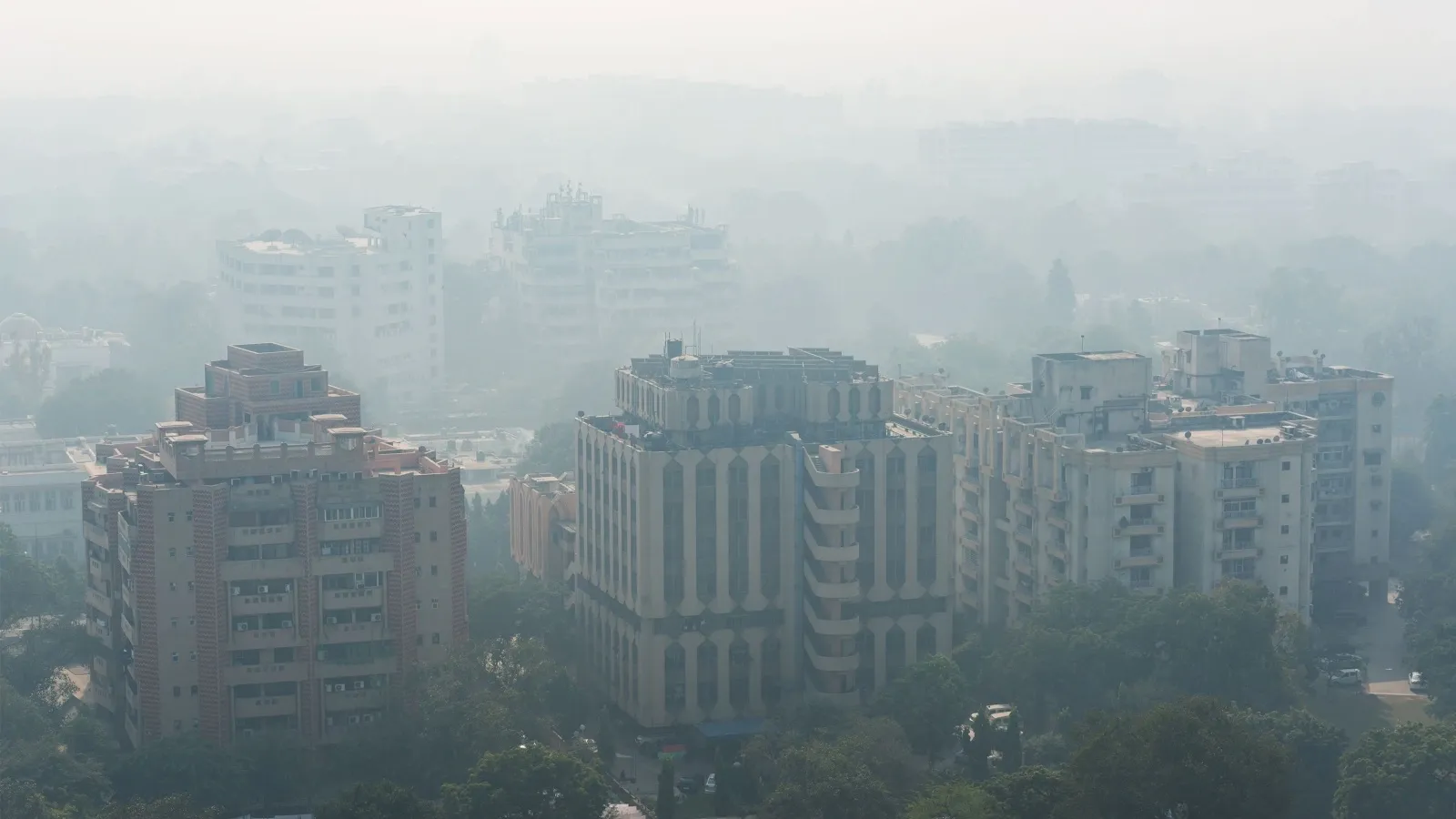
Commission for Air Quality Management has activated Stage-I of the Graded Response Action Plan across Delhi-NCR after the city’s AQI worsened to 226, placing it in the ‘poor’ category.
Data from the Central Pollution Control Board showed pollution levels rising due to unfavourable weather conditions. Image: Shutterstock
The Commission for Air Quality Management (CAQM) on Thursday invoked Stage-I of the Graded Response Action Plan (GRAP) across Delhi-NCR with immediate effect after the capital’s air quality slipped into the ‘poor’ category.
Delhi’s daily average Air Quality Index (AQI) stood at 226, placing it in the ‘poor’ category (201–300), Central Pollution Control Board (CPCB) data showed.
According to the CPCB, an AQI between zero and 50 is considered 'good', 51 to 100 'satisfactory', 101 to 200 'moderate', 201 to 300 'poor', 301 to 400 'very poor', and 401 to 500 'severe'.
The CAQM Sub-Committee on GRAP, which met to review the air quality situation, noted that pollution levels have been rising due to unfavourable meteorological conditions.
Forecasts by the India Meteorological Department (IMD) and the Indian Institute of Tropical Meteorology (IITM) indicate that the AQI is likely to remain in the ‘poor’ range over the next two days.
In view of the deteriorating air quality, the panel ordered the implementation of all 31 measures under Stage-I of GRAP throughout the National Capital Region.
GRAP Stage-I: Full list of measures enforced in Delhi-NCR
Dust control at construction sites: Strict enforcement of dust mitigation norms in construction and demolition (C&D) activities.
Mandatory project registration: Ban on large construction projects (≥500 sqm) not registered on government portals or lacking dust-control compliance.
Waste clearance: Regular lifting of municipal solid waste, C&D waste and hazardous waste; no illegal dumping.
Road dust management: Mechanised sweeping and water sprinkling on roads; proper disposal of collected dust.
Covered transport of materials: C&D materials must be stored, handled and transported in covered conditions.
Anti-smog guns: Mandatory deployment at construction sites based on project size.
Dust suppression in road works: Intensified sprinkling and suppression measures in road construction/repair.
Ban on open burning: Strict prohibition on burning of biomass and waste; penalties for violations.
Landfill monitoring: Vigil to prevent fires at dumping sites.
Traffic management: Deployment of traffic police at congestion points for smoother flow.
PUC enforcement: Strict checks on vehicle pollution certificates.
Action on polluting vehicles: Impounding or penalising visibly polluting vehicles.
Truck diversion: Enforcement of bypass routes for non-destined trucks via peripheral expressways.
Ban on overage vehicles: Enforcement of restrictions on old diesel/petrol vehicles.
Industrial crackdown: Legal action against non-compliant and illegal industrial units.
Emission norms enforcement: Strict adherence to pollution standards in industries, brick kilns and hot mix plants.
Clean fuel mandate: Only approved fuels allowed; closure for violations.
Thermal power compliance: Enforcement of emission norms in power plants.
Industrial waste disposal: Regular lifting and scientific disposal of industrial waste.
Firecracker ban: Enforcement of court-ordered restrictions on firecrackers.
Power supply management: Ensure uninterrupted electricity to reduce diesel generator use.
DG set restrictions: Diesel generators not to be used as regular power sources.
Clean fuel in eateries: Ban on coal/firewood in tandoors; shift to gas/electric appliances.
Public communication: Dissemination of pollution alerts via SMS, apps, and media.
Complaint redressal: Swift action on complaints via apps like Green Delhi, SAMEER, 311.
Workplace commute measures: Encourage unified transport for employees to reduce traffic.
Traffic synchronisation: Better coordination at intersections to ease congestion.
Public transport boost: Increase frequency and fleet of CNG/electric buses and metro; promote off-peak travel through differential pricing.
The CAQM has asked all implementing agencies, including pollution control boards of NCR states and the Delhi Pollution Control Committee, to strictly monitor and review compliance to prevent further deterioration in air quality.
It also urged residents to cooperate with authorities and adhere to the citizen charter under GRAP Stage-I to help mitigate pollution levels.
About The Author
Upstox News Desk is a team of journalists who passionately cover stock markets, economy, commodities, latest business trends, and personal finance.

.png)