
Trending
Nobel Prize in Medicine 2026: Karl Deisseroth, Peter Hegemann, Georg Nagel win for optogenetics
.png)
3 min read | Updated on October 05, 2026, 16:22 IST


SUMMARY
The Nobel Prize in Physiology or Medicine 2026 has been awarded for optogenetics, a method that makes it possible to show how nerve cells shape memories, feelings and behaviours in the living brain.
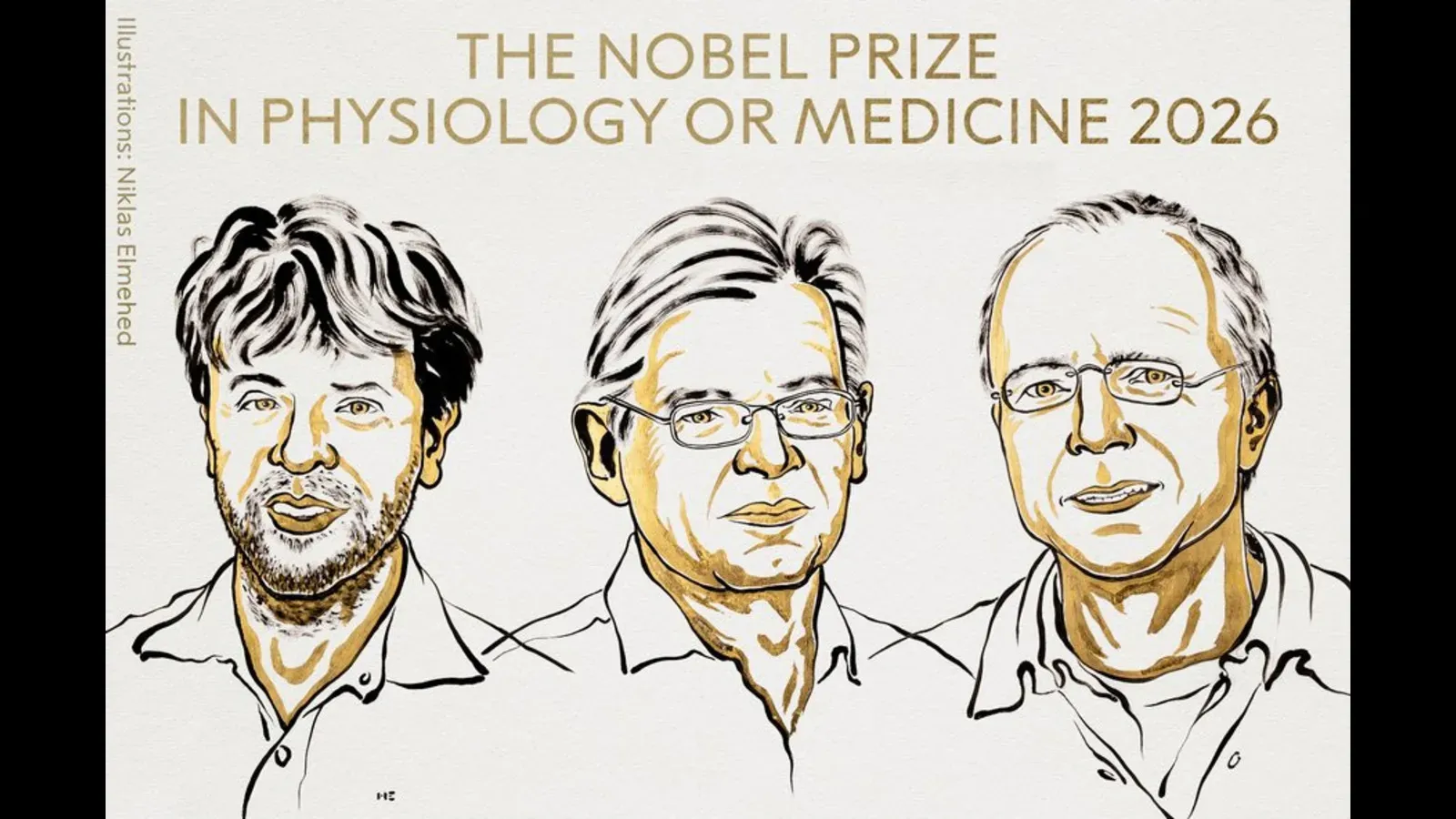
Scientists Karl Deisseroth, Peter Hegemann and Georg Nagel won the 2026 Nobel Prize in Physiology or Medicine on Monday for discoveries that enabled researchers to control nerve cells using light, transforming the study of the brain, a technique that has transformed the study of the brain.
The Nobel Assembly at Stockholm's Karolinska Institutet said the three were awarded the prize "for their discoveries concerning light-gated ion channels and optogenetics."
The Institutet said the three scientists were being honoured for laying the foundation of a new era in neuroscience by developing a method that allows researchers to control nerve cells with light.
"Optogenetics provides opportunities for mapping the brain in a way that we could once only dream of," said Per Svenningsson, chair of the Nobel Committee for Physiology or Medicine.
The brain's role in governing feelings, behaviour and bodily functions has long been a mystery.
Earlier methods enabled scientists to identify brain regions associated with particular functions but could not establish clear cause-and-effect relationships.
The work of the three laureates changed that.
Hegemann, a German scientist at Humboldt University of Berlin, investigated how the alga Chlamydomonas moves towards light.
In the early 2000s, he and Nagel, of the University of Würzburg, discovered channelrhodopsin, a protein that acts as a light-sensitive channel on the surface of the cell.
When exposed to blue light, the channel opens and allows charged ions to flow into the cell, generating an electrical signal.
The researchers found that introducing the protein into other cells could make them responsive to light.
Deisseroth, a US scientist at Stanford University and the Howard Hughes Medical Institute, then introduced the gene for channelrhodopsin into rat nerve cells.
In 2005, he showed that blue light could be used to trigger nerve signals in those cells. In 2007, he demonstrated that the technique could control nerve cells in the brains of living mice.
The technique, now known as optogenetics, has rapidly become a widely used tool in neuroscience.
Researchers have used it to identify neural circuits involved in specific memories, feelings and behaviours, providing new insights into neurological and psychiatric disorders.
The technique is also being explored in clinical medicine, including efforts to restore sight in people with visual impairment.
The prize recognises work that has helped move neuroscience beyond simply mapping which parts of the brain are associated with particular functions, towards testing whether specific neural circuits actually cause those functions.
Deisseroth, born in 1971, is professor of bioengineering and of psychiatry and behavioural sciences at Stanford University. Hegemann, born in 1954, is Hertie Senior Professor of Neuroscience at Humboldt University of Berlin, while Nagel, born in 1953, is professor of molecular plant physiology at the University of Würzburg.
The prize carries a cash award of 12 million Swedish kronor, to be shared equally among the three laureates.
The medicine prize is the first of the 2026 Nobel awards. The prizes for physics, chemistry, literature, peace and economics will be announced over the coming days.
About The Author
Next Story
