
Trending
A railway station, a childhood and 79 years of India
4 min read | Updated on August 13, 2026, 18:39 IST


SUMMARY
India has travelled a very long distance as a country. But a journey is not judged only by how far the train has come. It is also judged by where it is headed.
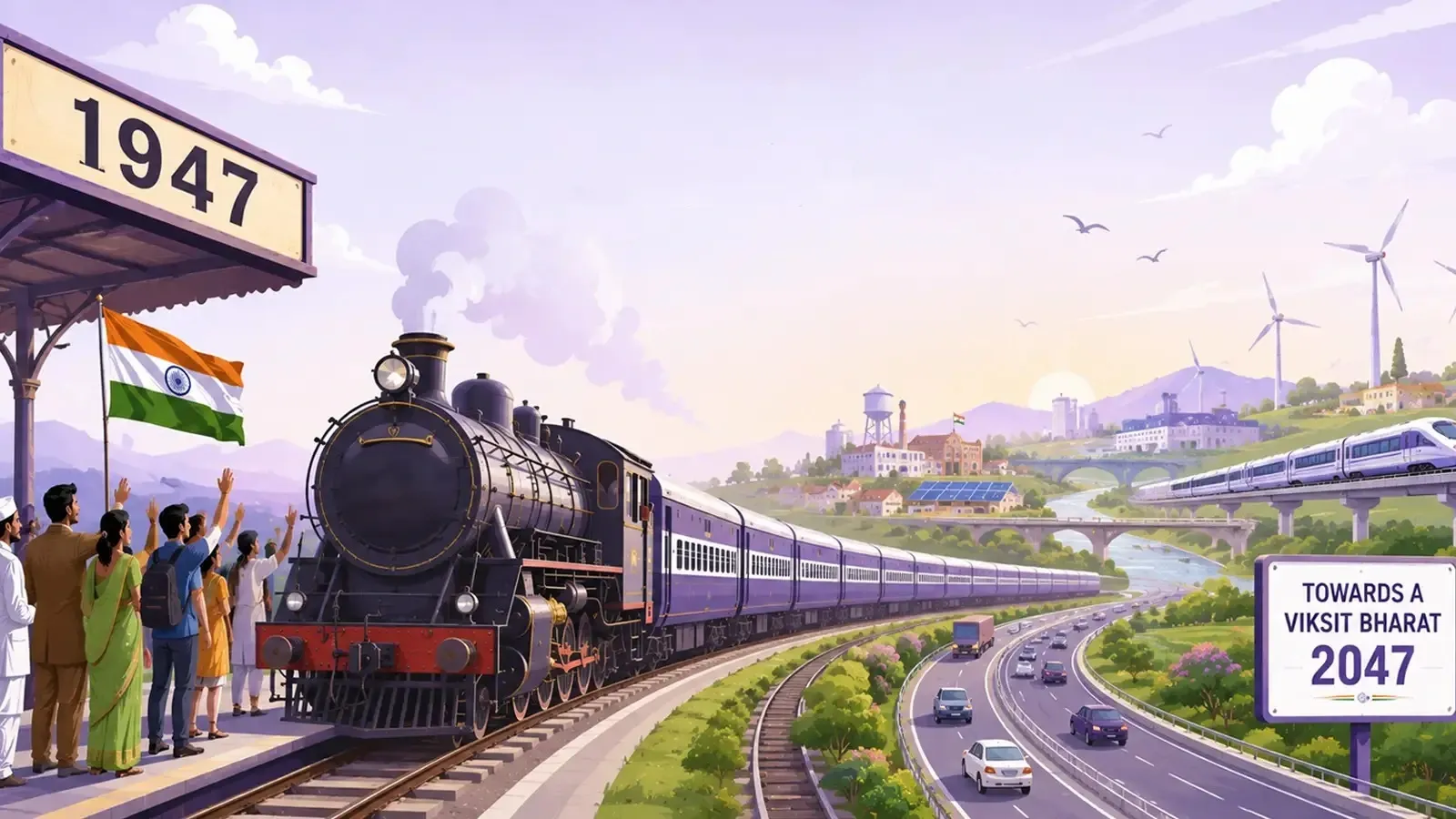
A train leaving on time, a road connecting a remote village to a city are all indicators of progress.
After a long time, on 10 August, I travelled on the August Kranti Rajdhani Express from Delhi to Mumbai. The train, now running in its upgraded Tejas avatar, pulled out of the station exactly at its scheduled time.
I was pleasantly surprised.
Sitting beside me was a veteran politician and former member of parliament. He watched the train leave with the calmness of someone for whom punctual trains were hardly an event. I, on the other hand, couldn't resist saying, "We have made great progress as a nation. When I was a child, trains rarely left on time."
He simply nodded and smiled without making any statement or validating mine. Just a smile that left no note for me.
That small moment took me back to my childhood.
I am now in my mid-40s, but I still remember spending hours at railway stations waiting for trains. Sometimes the wait seemed endless. A train’s arrival and departure were both major events.
The village I grew up in is close to a railway station in Bihar—Hayaghat, which lies between Darbhanga and Samastipur, on the rail line that connects North Bihar to Kolkata, Delhi and other parts of the country.
The Hayaghat reminds me of the Malgudi station of R. K. Narayan’s epic tale, Malgudi Days. While Malgudi was fictional, Hayaghat is real, where I grew up seeing the station serve as a local marketplace for nearby villagers who would gather to shop for groceries, fruits, chai and biscuits. Some of them would also take the train to Darbhanga or Samastipur and then catch connecting trains to Kolkata, Delhi or elsewhere.
The station now is a modern structure, replacing the old red-brick house of the past. It is electrified, with trains running fast without billowing smoke or whistling in the signature steam-engine tune.
The station, on the banks of the River Kareh, once used to handle around five to seven passenger trains a day. Today, it has dozens of trains to Bengaluru, Mumbai and Hyderabad passing through daily.
The platform that used to serve as a local marketplace or haat has been expanded and raised to serve broad-gauge trains, and the nearby area has developed into a full-fledged market with town-like shops.
And here we were, decades later, watching our train leave the station precisely on time.
In its own quiet way, it felt like a symbol of progress.
The man sitting beside me had witnessed much more of India's journey than I had. As a veteran member of parliament he had seen political upheavals, economic reforms, technological revolutions and a transformation in the way Indians travel, communicate, work and live.
I wanted his validation of what I had just described as progress, so I tried to take the conversation further.
His response made me look at the moment differently.
He said that what I remembered from 30 or 40 years ago was not simply an India where trains were late. It was an India still building itself. A young nation was trying to leave behind the scars of the freedom struggle and the partition. It was creating institutions, expanding its infrastructure and slowly finding its place in a world increasingly shaped by science and technology. Then, he added, a railway line connecting distant parts of the country was itself an achievement. A train, even a delayed one, connecting people across the length and breadth of the country represented progress. What seems ordinary today was extraordinary then.
And perhaps that is how development should be understood. Not merely through GDP numbers, infrastructure statistics or economic rankings, but through the ordinary things that gradually become possible.
A train leaving on time, a road connecting a remote village to a city, a young person from a small town accessing opportunities in a big city—these are all indicators of progress.
Today, watching a train pull out of a station at precisely the scheduled time may seem completely ordinary, but it is a marker of how far we have travelled.
Having lived through over 40 of those 80 years, I have seen enormous change. I have seen an India that was slower, poorer and less connected become more confident, ambitious and technologically capable.
The parliamentarian beside me had seen even more of that transformation. His generation had lived through the difficult years of nation-building. My generation inherited some of that foundation and watched India accelerate.
His generation built the tracks. Ours has watched the trains gather speed.
India has travelled a very long distance as a country. But a journey is not judged only by how far the train has come. It is also judged by where it is headed.
As I watched the August Kranti Express leave the station on time, I found myself thinking that perhaps this, too, is India in motion.
About The Author
Next Story
