
Personal Finance News
November 30 income tax deadline: Who needs to file Forms 10E and 10BA? Check eligibility

7 min read | Updated on November 27, 2026, 15:48 IST

SUMMARY
November 30 is the deadline for certain taxpayers to file Form 10E and Form 10BA. Check who needs to submit these income tax forms.
November 30, 2026, is an important income tax compliance deadline for certain taxpayers. | Image: Shutterstock.
November 30, 2026, is an important income tax compliance deadline for certain taxpayers, including those claiming tax relief on salary arrears and individuals seeking a deduction for rent paid under Section 80GG of the Income-tax Act, 1961.
However, these deadlines do not apply to every taxpayer. According to the Income Tax Department's compliance calendar, the November 30 deadline applies where the assessee is required to furnish the income tax return on or before November 30, 2026.
Form 10E: Received salary arrears? You may need to file this form
Employees who receive salary arrears or advance salary may face a higher tax liability because the additional income could push them into a higher tax slab in the year of receipt.
Section 89 of the Income-tax Act, 1961, provides relief in certain cases where an individual receives salary or other eligible payments in arrears or in advance, resulting in a higher tax liability.
According to the Income Tax Department, Form 10E is mandatory for taxpayers seeking relief under Section 89. The form must be furnished before filing the income tax return.
Form 10E is not restricted to salary arrears. The Income Tax Department's user manual also covers eligible receipts such as family pension, gratuity, compensation on termination of employment and commuted pension.
Who should check whether Form 10E applies?
-
Employees who have received salary arrears.
-
Employees who have received salary in advance.
-
Eligible individuals who have received family pension, gratuity, retrenchment compensation or commuted pension and are claiming relief under Section 89.
-
Taxpayers whose applicable ITR filing deadline is November 30, 2026, should ensure that Form 10E is furnished before filing their returns.
Form 10BA: Paying rent without receiving HRA? Check this deduction
Individuals who pay rent for residential accommodation but do not receive House Rent Allowance (HRA) as part of their salary may be eligible to claim a deduction under Section 80GG of the Income-tax Act, 1961, subject to prescribed conditions.
This provision can also apply to self-employed individuals who pay rent for residential accommodation.
To claim the deduction, taxpayers must furnish Form 10BA, which contains details of the rent paid and the residential accommodation.
The Income Tax Department states that filing Form 10BA is mandatory for claiming the deduction under Section 80GG. Taxpayers must also enter the acknowledgement number of Form 10BA in Schedule 80GG while filing their income tax returns.
The deduction is subject to prescribed limits and eligibility conditions. Simply paying rent or not receiving HRA does not automatically make an individual eligible.
Who should check whether Form 10BA applies?
-
Salaried individuals who do not receive HRA as part of their salary.
-
Self-employed individuals paying rent for residential accommodation.
-
Other eligible taxpayers seeking a deduction under Section 80GG.
-
Taxpayers claiming this deduction should ensure that Form 10BA is furnished before filing their income tax returns.
-
Those whose applicable return-filing deadline is November 30, 2026, should complete the form within the relevant timeline.
Which Income-tax Act applies to these filings?
The transition to the Income-tax Act, 2025, which came into effect on April 1, 2026, has changed the numbering of several provisions and forms.
However, the Income Tax Department has clarified that income earned during FY 2025-26 will be reported in the return for Assessment Year 2026-27 under the Income-tax Act, 1961.
Therefore, taxpayers claiming relief under Section 89 for AY 2026-27 must use Form 10E under the old Act. The corresponding Form 39 under the Income-tax Act, 2025, applies to claims governed by the new Act from Tax Year 2026-27 onwards.
Similarly, Form 10BA and Section 80GG continue to apply to eligible claims for AY 2026-27.
Other important income tax deadlines on November 30, 2026
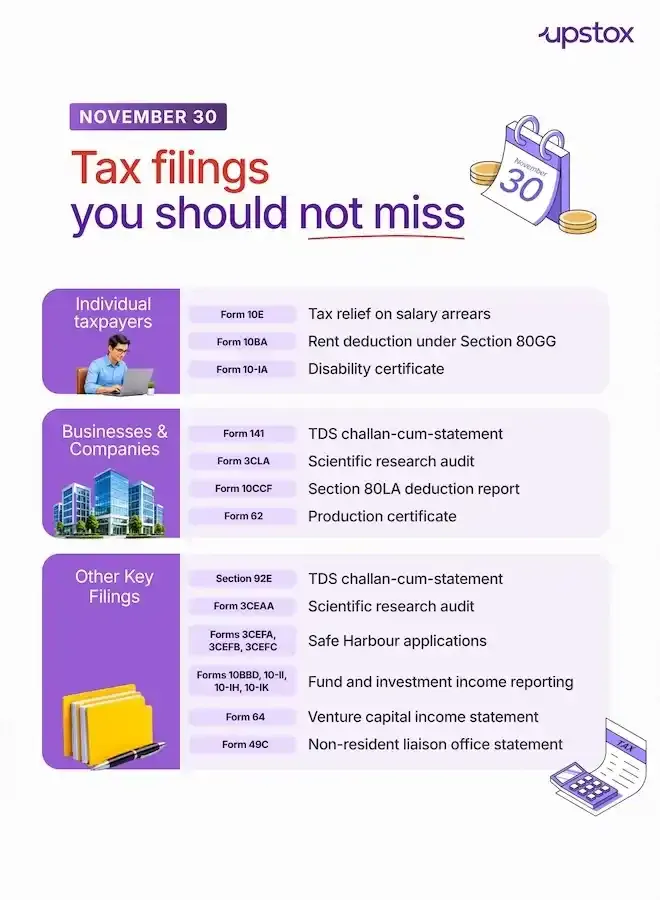
Apart from Forms 10E and 10BA, the Income Tax Department's compliance calendar lists several other tax filing and reporting requirements due on November 30, 2026.
The calendar also lists these reporting requirements:
For Forms 10BBD, 10-II, 10-IH and 10-IK, the November 30 deadline applies where the assessee's ITR is due by that date.
Several of these specialised forms are due only where the taxpayer's income tax return is required to be filed by November 30. Others have separate filing requirements as specified in the department's calendar.
What should taxpayers do?
Taxpayers and businesses should check the Income Tax Department's November 2026 compliance calendar to identify the forms applicable to them. Individuals claiming relief under Section 89 or deductions under Section 80GG should pay attention to Forms 10E and 10BA, while companies, international groups and investment funds should review their respective reporting obligations.
Taxpayers should also verify the applicable assessment year and form requirements before filing.
Related News


About The Author
Next Story

