
Market News
Week ahead: Crude Oil prices, India GDP, auto sales data and FIIs activity among key market triggers to watch
.png)
5 min read | Updated on August 30, 2026, 11:43 IST


SUMMARY
In the week ahead, India’s GDP data will provide fresh signals on domestic growth. Globally, the US jobs report could influence interest-rate expectations after the Jackson Hole meeting. Crude oil and developments around the Strait-of-Hormuz will remain important for the rupee, inflation and oil-sensitive sectors.

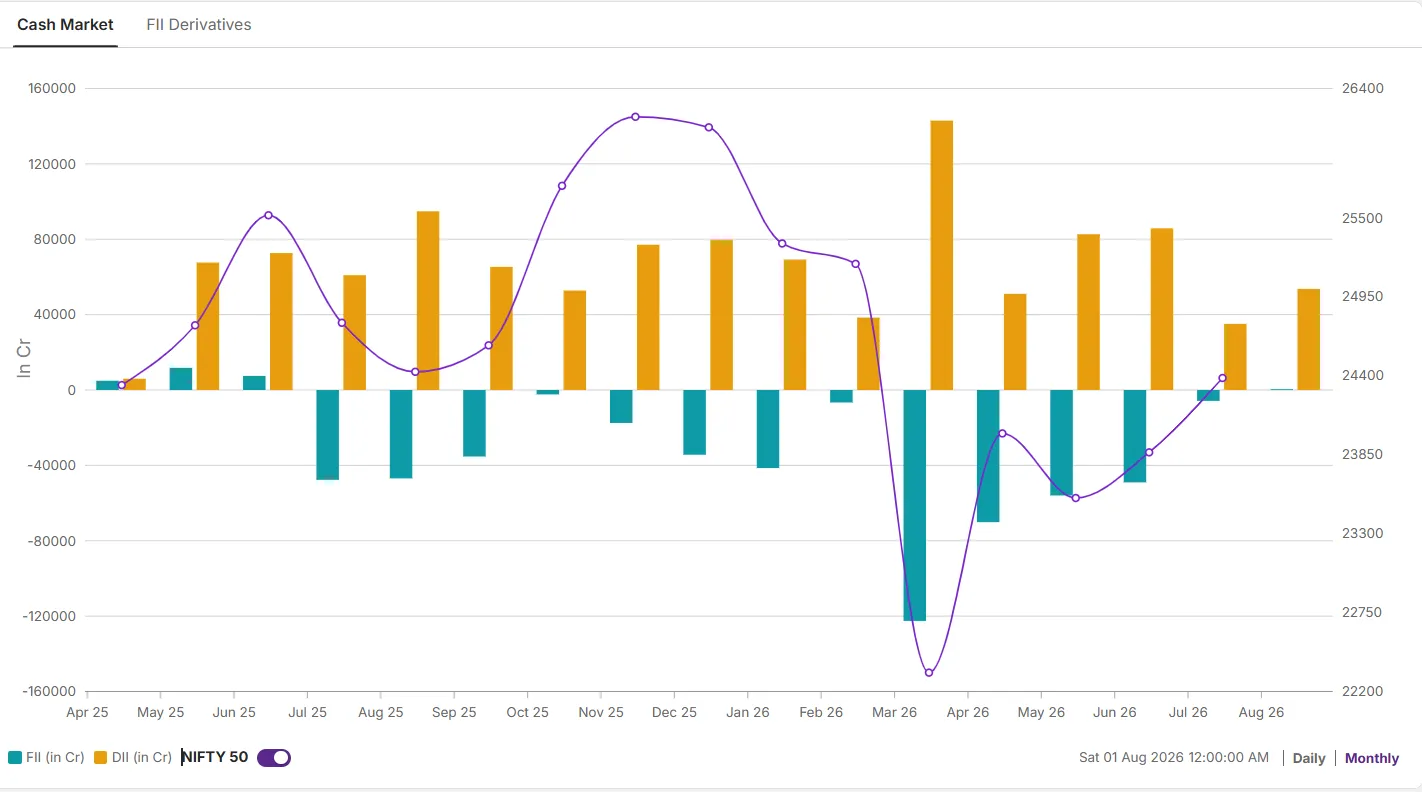
Foreign institutional investors (FIIs) remained cautious in August and were net buyers in the cash market worth ₹454 crore.
Indian markets extended the decline for the third week in a row and both indices registered the longest losing streak in five months. Elevated crude prices, uncertainty over U.S. interest rates and expiry-related movements kept investors cautious.
Meanwhile, the new closing-auction mechanism contributed to sharp price changes around the monthly derivatives expiry. Weakness in Reliance Industries, HDFC Bank and Bharti Airtel also weighed on the benchmarks. As a result, the NIFTY50 declined 0.3% to 24,175, while the Sensex slipped 0.4%to 77,264.
The broader markets, however, performed better than the headline indices. The Nifty Midcap 150 index and Smallcap 250 index gained around 0.4 % each during the week, indicating continued interest in stocks outside the large-cap space. This relative outperformance also showed that selling pressure was concentrated in select benchmark heavyweights rather than spread across the entire market.
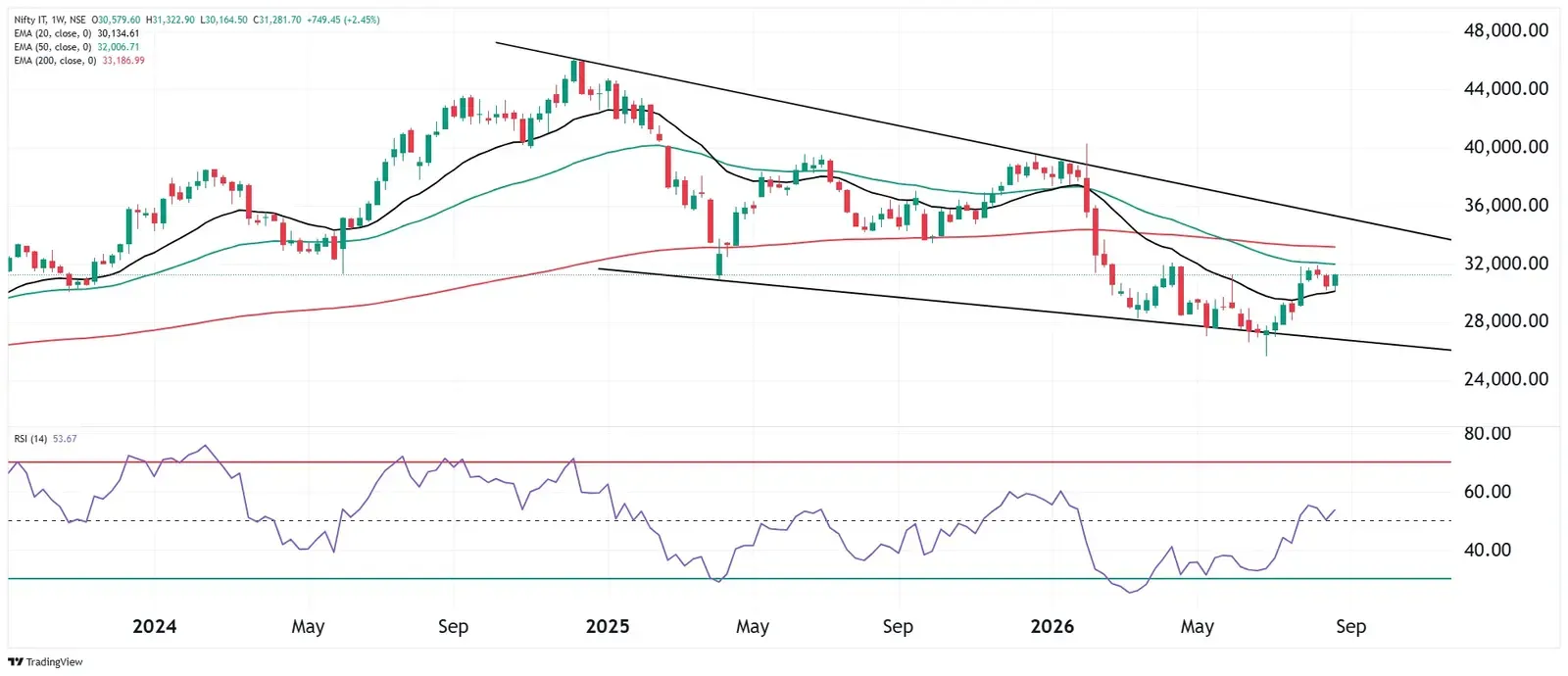
Sectoral performance remained mixed, with 10 of the 16 major sector indices ending lower. IT was the clear outperformer, with the index gaining 2.4% after Nvidia’s strong results improved sentiment towards global technology stocks. Metals (+2.6%) and Pharma (+2.4%) stocks also showed relative strength. On the other hand, FMCG (-1.5%), Oil and Gas (-1.0%), Automobiles (-0.9%) remained under pressure.
This global rotation supported Indian IT companies. Additionally, a weaker rupee and attractive valuations following the sector’s earlier correction also encouraged value buying. Coforge led the gains along with LTIMindtree, rising 6% and 4% for the week, while TCS and Infosys advanced around 2% each.
Globally, the main event will be the U.S. jobs report on Friday, September 4. The non-farm payrolls, unemployment rate and wage-growth data could influence expectations for Federal Reserve policy and drive movements in the dollar, U.S. bond yields and global equity markets.
For India, the weekly fall in crude provides some relief for the import bill, rupee and inflation outlook. Sustained prices near or above $90 would remain a concern for fuel costs and the margins of aviation, paints, tyres and other crude-dependent industries.
Market breadth
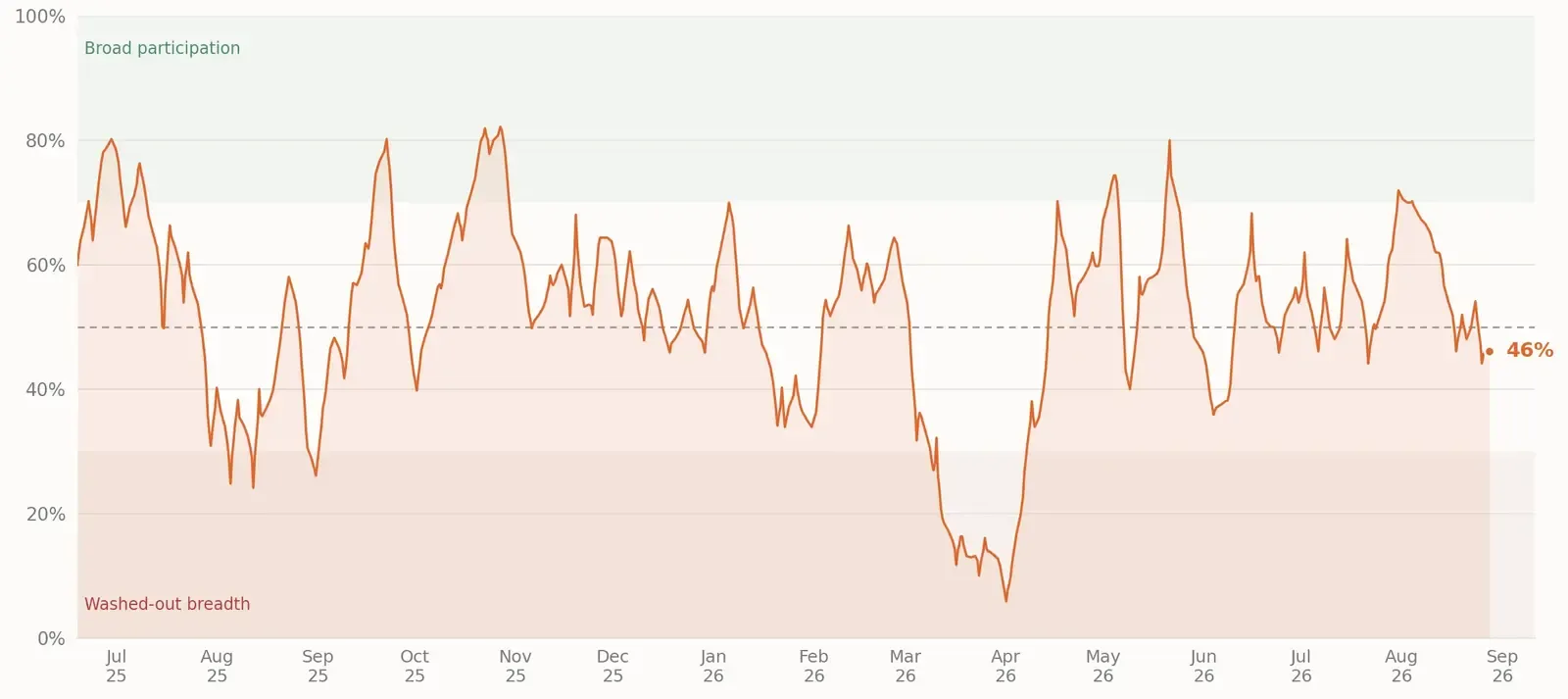
Market breadth weakened further during the week, with only 46% of NIFTY50 stocks trading above their 50-day moving average, down from 50% in the previous week. The reading has now slipped below the neutral 50 % level, indicating that weakness is gradually spreading beyond a few index heavyweights. However, breadth is not yet in the washed-out zone. A recovery above 50% would indicate improving participation, while a sustained decline towards 30 % would point to broader selling pressure.
Foreign investors positioning
Foreign institutional investors remained cautious during August and were marginal net buyers in the cash market for ₹454 crore. The limited foreign participation came amid elevated crude-oil prices and pressure on the rupee.
Domestic institutional investors continued to provide strong support, purchasing shares worth more than ₹50,000 crore during the month. Their sustained buying helped absorb foreign selling and supported the broader market despite three consecutive weekly declines in the benchmark indices.
NIFTY50 outlook
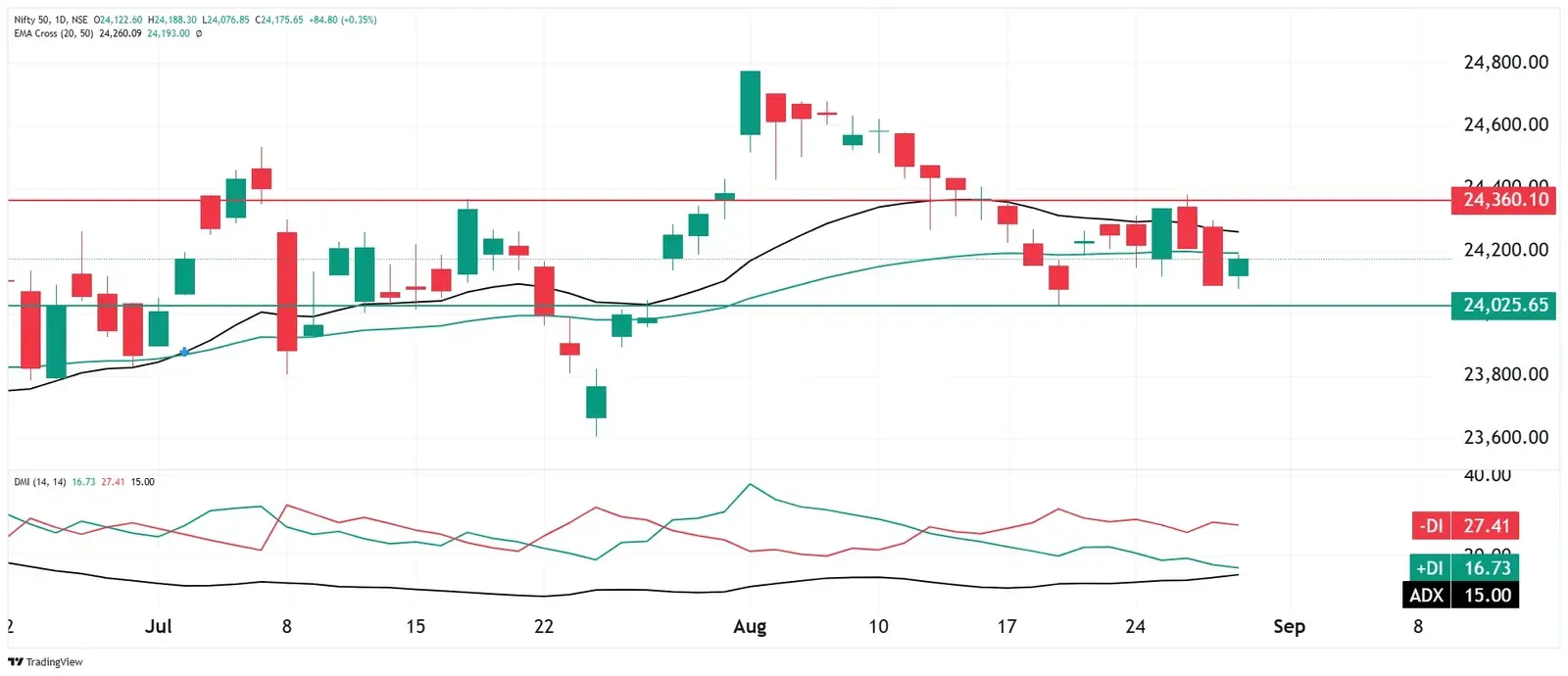
The NIFTY50 closed below its 20-day exponential moving average (EMA) and marginally below the 50-day EMA. The index continues to form lower highs after its early-August peak, keeping the short-term structure weak. However, the ADX reading of 15 suggests that the decline has not yet developed into a strong directional trend.
On the upside, the index must first reclaim the 24,260 zone. A decisive close above 24,360 could improve momentum and open the way towards 24,600. On the downside, 24,025 remains the crucial support. As long as this level holds, the index may continue consolidating between 24,025 and 24,360. A decisive close below 24,025 could strengthen the bearish setup and extend the decline towards 23,800.
Disclaimer:
Derivatives trading must be done only by traders who fully understand the risks associated with them and strictly apply risk mechanisms like stop-losses. We do not recommend any particular stock, securities, or trading strategies. The securities quoted are exemplary and not recommendatory. The stock names mentioned in this article are purely to show how to do analysis.
About The Author
Next Story

