
Market News
Bajaj Finance Q2 results: NII and net profit likely to see double-digit growth driven by strong AUM and loan growth

5 min read | Updated on October 19, 2026, 11:50 IST


SUMMARY
Bajaj Finance will announce its Q2FY27 results on Monday, October 19, after market hours. The NBFC is expected to report strong double-digit growth in net interest income and net profit, supported by 26.5% AUM growth. Margins, loan growth and asset quality are in focus.
Stock list

Bajaj Finance reported 11% YoY growth in new loans booked, at 1.34 crore in September quarter.
Leading NBFC Bajaj Finance will announce its September quarter (Q2FY27) results on Monday, October 19, 2026. The earnings are likely to be announced after market hours.
Bajaj Finance Q2FY27 business update
In its quarterly business update, Bajaj Finance reported 11% YoY growth in new loans booked, at 1.34 crore. Its total assets under management (AUM) grew 26.5% YoY to ₹5.84 lakh crore as of September 30, 2026. Its total customer franchise stood at 12.8 crore.
What to expect from Bajaj Finance’s Q2 results
According to experts, Bajaj Finance could report double-digit growth in net interest income (NII) and net profit for the September quarter, supported by strong loan growth and higher interest income.
Bajaj Finance’s NII is expected to be between ₹12,950 crore and ₹13,390 crore, up 20% to 24% from ₹10,785 crore a year ago. Net profit could rise 26% to 29% YoY to between ₹6,250 crore and ₹6,390 crore. Bajaj Finance reported a net profit of ₹4,948 crore in Q2FY26 and ₹6,081 crore in the previous quarter.
Despite healthy growth in key metrics, Bajaj Finance’s net interest margin (NIM) could remain flat at around 9.3% to 9.4%, as borrowing costs remain high. During the Q2 results announcement, investors will keenly watch management commentary on loan book growth, NIM, and gross and net non-performing assets (NPAs).
Ahead of the Q2 results, Bajaj Finance shares closed 1.7% higher at ₹982 on Friday, October 16. The stock has been largely flat this year, down 0.4% so far in 2026, amid a sell-off in the broader market.
Bajaj Finance technical outlook ahead of Q2 results
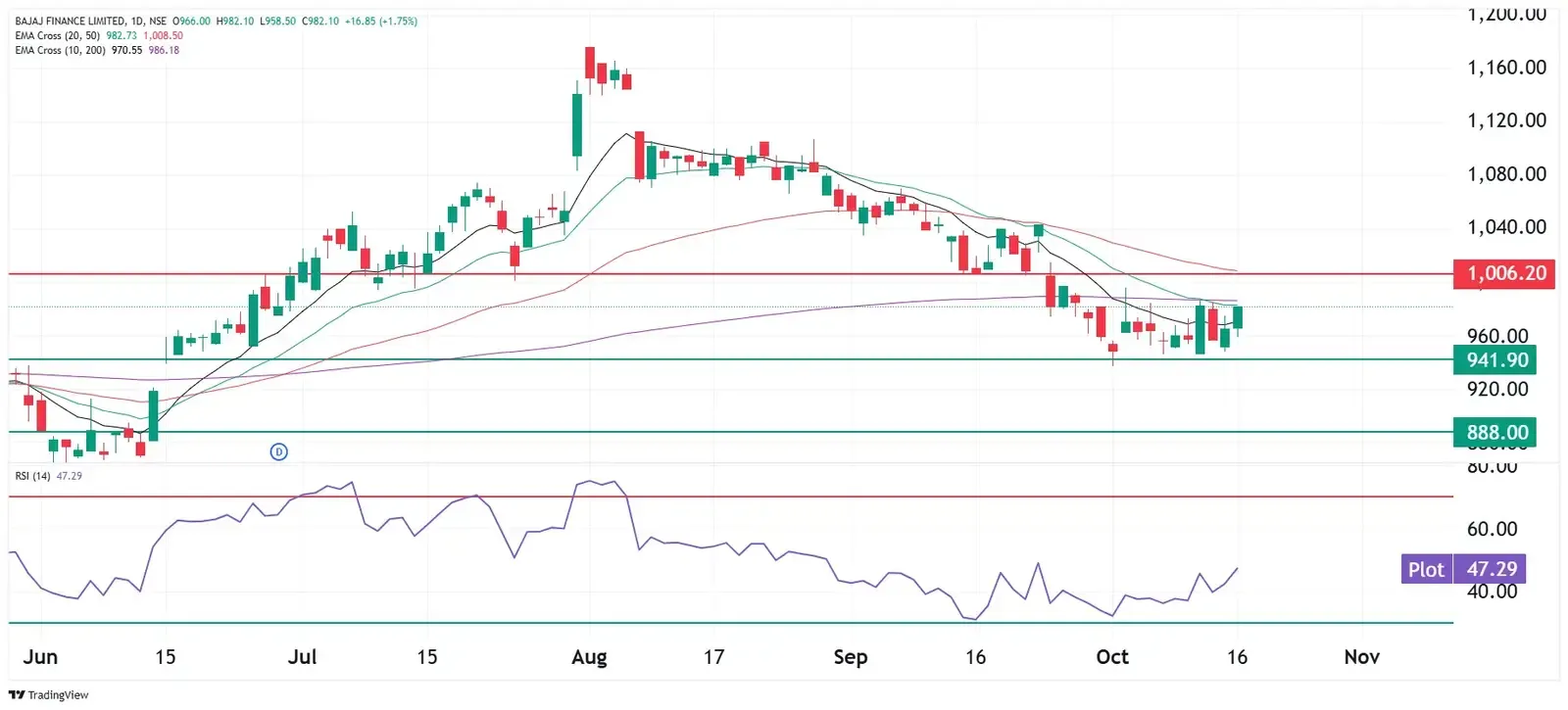
Bajaj Finance goes into its Q2FY27 results right at a key level: its 200-day EMA. The stock sits below both the 200-day EMA and the 20-day EMA. A close above this zone would put the stock back above its long-term average, which it fell below in late September for the first time since June.
After hitting a high near ₹1,175 in early August, Bajaj Finance fell about 20% to a low of ₹942 on October 1. Since then, it has moved sideways between roughly ₹945 and ₹985 for nearly three weeks. This suggests selling has slowed, but buyers have not yet taken control.
The Relative Strength Index (RSI) tells a similar story. It has recovered from near 32 at the start of October to 47 now. Momentum is improving, but RSI is still below 50, so the stock has not yet turned positive.
Bajaj Finance options: how big a move is priced in?
With Bajaj Finance futures at ₹985, the at-the-money call is at 980 with a combined premium of ₹46.15. This means the options market expects a move of about ±4.7% by the October 27 expiry, which puts the expected range at roughly ₹939 to ₹1,031.
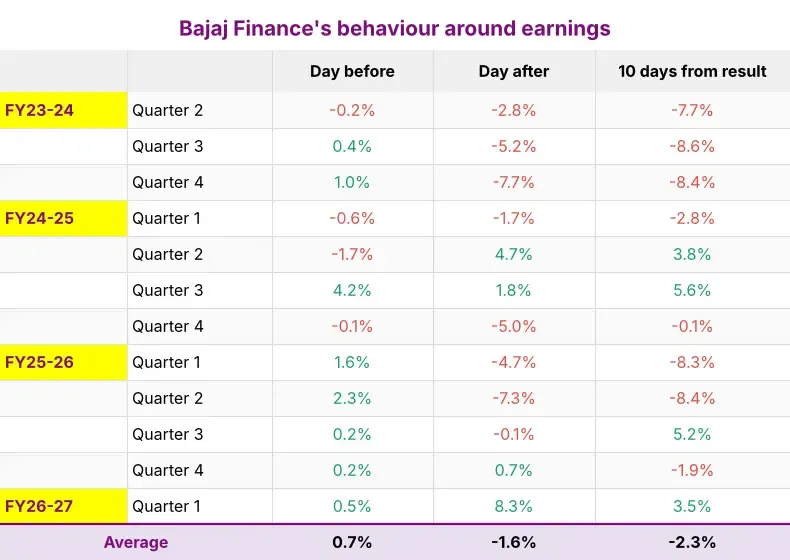
As highlighted in the graph below, Bajaj Finance has often reacted sharply to its results. In five of the last 12 quarters, the stock moved more than 4.7% on the day after the results, and in two more it moved exactly 4.7%. Most of these big moves were falls, including drops of 7.7% after Q4FY24 and 7.3% after Q2FY26. However, the latest reaction was the biggest of all: an 8.3% rise after the Q1FY27 results.
Over 10 days, the stock moved more than 4.7% in seven of the last 12 quarters.
Options strategy for Bajaj Finance Q2 results
If you expect a big move after the results: A long straddle, buying the ATM call and put, could be considered. Bajaj Finance’s history of sharp post-results moves supports this view. The strategy makes profit if the stock moves below roughly ₹934 or above ₹1,026 by expiry. However, option premiums usually fall sharply the morning after the results, so the stock needs to move quickly for this trade to work.

If you expect the stock to stay in a range: A short straddle, selling the ATM call and put, could be considered. The stock has traded between ₹942 and ₹985 for nearly three weeks, and the strategy makes profit if it stays between roughly ₹934 and ₹1,026 until expiry. However, Bajaj Finance has often moved more than the current pricing after its results, so this trade carries higher risk than usual.

If you want to trade a move in one direction: Traders can wait for the stock to break out of its range. If Bajaj Finance closes above ₹1,008, a bull put spread could be considered. If it closes below the ₹942 support, a bear call spread may be more suitable.
About The Author
Next Story

