
Market News
₹24,040 crore chased gold at the peak. How much have investors lost?

6 min read | Updated on November 20, 2026, 15:36 IST

SUMMARY
Gold ETFs saw a record ₹24,040 crore of inflows in January 2026, just as gold hit an all-time high. Since then, gold prices have fallen to a 14-month low, pulling the NAV of Gold BeES down to ₹107.78. Depending on when they bought, January investors are down 2% to over 25%. More broadly, every month's gold ETF inflows in 2026 are now in the red, with the ₹49,399 crore invested through October sitting on an estimated paper loss of about ₹5,900 crore.

Gold ETFs pulled in a record ₹24,040 crore in January 2026. | Image: Shutterstock
On January 29, gold looked unstoppable. It crossed $5,500 an ounce and touched a record high, and Nippon India ETF Gold BeES, the country's biggest gold ETF, closed at an all-time high NAV of ₹144.57. Indians had put a record ₹24,040 crore into gold ETFs that month, slightly more than what went into equity-oriented mutual funds, and opened some 12 lakh new folios.
Less than 10 months later, the mood has changed. On November 18, gold slipped to around $3,720, its lowest since September 2025, and Gold BeES's NAV ended at ₹107.78, a little below where it started the year. So, how much have January's buyers lost?
What happened to January's money
It depends on when they bought. If all of the ₹24,040 crore had gone in at January's average NAV of ₹120.84, it would now be sitting on a loss of nearly 10.8%, or about ₹2,600 crore. If more of it came in late in the month, when prices were higher, the loss would be bigger.
Those who bought on January 29 have lost the most. They are down 25.4%, and Gold BeES would have to rise by over 34% from here just to get back to that day's NAV. If all of January's money had gone in at the peak, the loss would be closer to ₹6,100 crore.
Some investors also paid more than the NAV when they bought on the exchange. On January 21, for example, Gold BeES closed at ₹134.94 on BSE, about 6% above its NAV of ₹127.02. Is an asset really safe if you have to pay a premium just to buy it?
On average, every month's money is in the red
Investors kept buying in the months that followed. Every month up to October saw net inflows except May, when there was a net outflow of ₹725 crore. Net inflows from January to October added up to ₹49,399 crore, more than the ₹42,961 crore that came in during the whole of 2025.
Gold BeES's average NAV has been above ₹107.78 in every month of 2026. That means money invested between January and October is down 8% to 16% on average, depending on the month. July's money has lost the least and February's the most. Across these 10 months, the estimated paper loss adds up to about ₹5,900 crore.
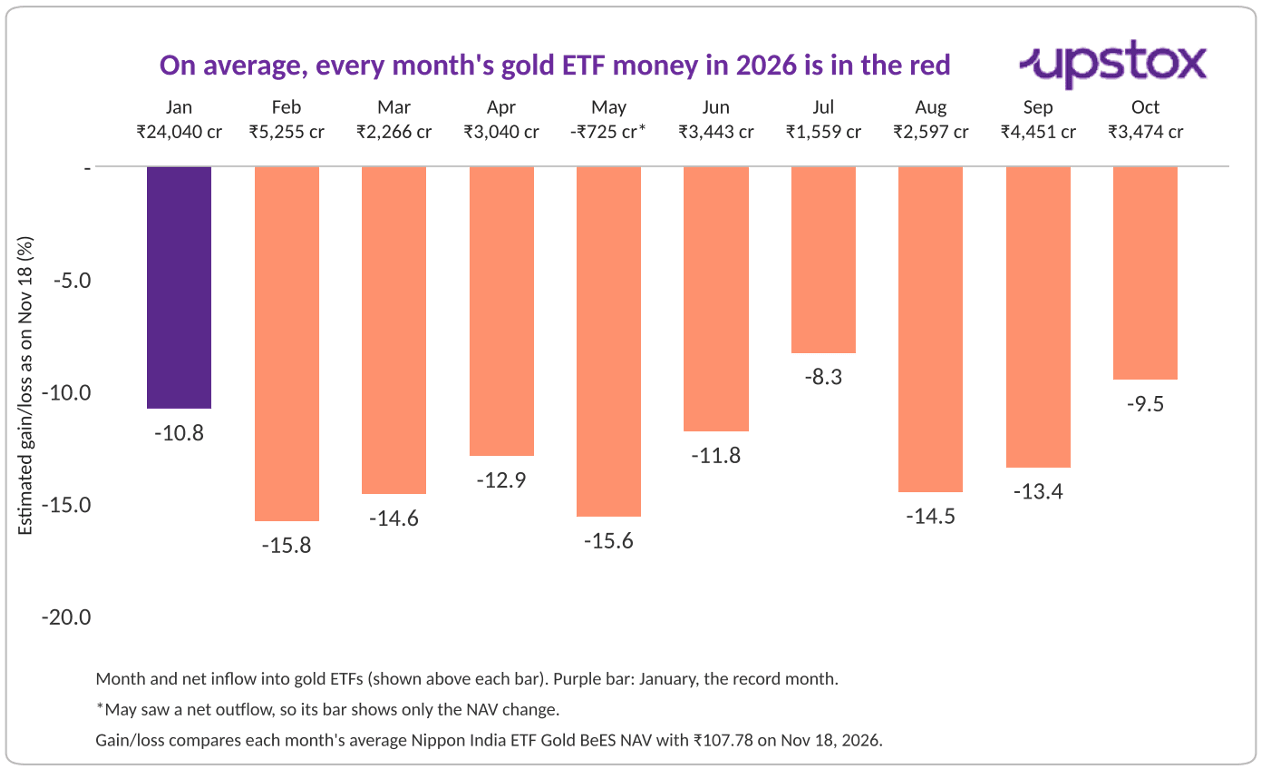
Source: AMFI monthly data and Nippon India ETF Gold BeES NAVs, January 1 to November 18, 2026.
Total gold ETF assets under management (AUM) tell a similar story. AUM stood at ₹1,84,277 crore at the end of January, and investors added about ₹25,359 crore more between February and October. Yet AUM at the end of October was only ₹1,79,894 crore. In other words, about ₹29,700 crore of value was wiped out, and that was before Gold BeES fell another 6.3% in November.
Table 1: Gold ETF inflows in 2026 and where they stand now
| Month (2026) | Net inflow (₹ crore) | Average Gold BeES NAV (₹) | Change to Nov 18 NAV (%) | Estimated gain/loss (₹ crore) |
|---|---|---|---|---|
| January | 24,040 | 120.84 | -10.8 | -2,599 |
| February | 5,255 | 128.02 | -15.8 | -831 |
| March | 2,266 | 126.20 | -14.6 | -331 |
| April | 3,040 | 123.71 | -12.9 | -391 |
| May | -725 | 127.63 | -15.6 | 113 |
| June | 3,443 | 122.21 | -11.8 | -407 |
| July | 1,559 | 117.55 | -8.3 | -130 |
| August | 2,597 | 126.04 | -14.5 | -376 |
| September | 4,451 | 124.44 | -13.4 | -596 |
| October | 3,474 | 119.08 | -9.5 | -330 |
| Total | 49,399 | About -5,900 |
Note: Net inflows into all gold ETFs as reported by AMFI. Estimated gain/loss assumes each month's net inflow went in at that month's average Nippon India ETF Gold BeES NAV and compares it with the NAV of ₹107.78 on November 18, 2026. May saw a net outflow; the total nets it off, and leaving May out, the estimated loss is about ₹6,000 crore. Figures may not add up due to rounding.
Why Indian investors lost less than the world
Still, it could have been worse. Gold has been dragged down by a strong US dollar, which touched a 19-month high, and by expectations of more US interest rate hikes. Global prices are about 33% below their January record, while Gold BeES is about 25% lower.
Two things have cushioned Indian investors. First, the rupee has weakened slightly against the dollar, from around 92 when gold peaked to 93.51 on November 17. Second, the import duty on gold went up from 6% to 15% on May 13, which pushes up local prices. Because gold ETFs value their holdings at domestic prices (from April 1, 2026, the spot prices published by Indian exchanges), the higher duty shows up in their NAVs. So what happens to ETF investors if the duty is cut again?
Are investors still buying?
Since January, investors have turned more cautious. Inflows dropped to ₹5,255 crore in February from ₹24,040 crore in January, and have ranged between ₹1,500 crore and ₹4,500 crore a month since June. Some fund houses capped large investments in June, and in mid-October, 17 fund houses stopped accepting fresh money into their gold fund of funds. October inflows fell 22% to ₹3,474 crore. Even so, gold ETF folios rose to 1.27 crore by the end of October, about 25 lakh more than at the end of 2025, and almost half of that increase came in January. How many of these investors will stay the course?
Conclusion
January 29 and November 18 could hardly look more different. On January 29, Gold BeES's NAV was ₹144.57, money was pouring in at a record pace and gold was at an all-time high. On November 18, the NAV was ₹107.78. Depending on the day they bought, January's investors are down anywhere from 2% to over 25%, and money put in during any month this year is, on average, sitting on a loss. Gold has gone through long flat spells in the past before turning around, so it is hard to say what the coming months will bring. For now, 2026 has shown that the price you pay can matter as much as what you buy.
About The Author
Next Story

