
Business News
India's commute bill: Workers spend ₹785 a month on average, urban cost 70% higher

3 min read | Updated on October 06, 2026, 11:52 IST


SUMMARY
The survey, conducted by the NSO from July 2025 to June 2026, covered 4,92,023 households and 20,34,371 people.
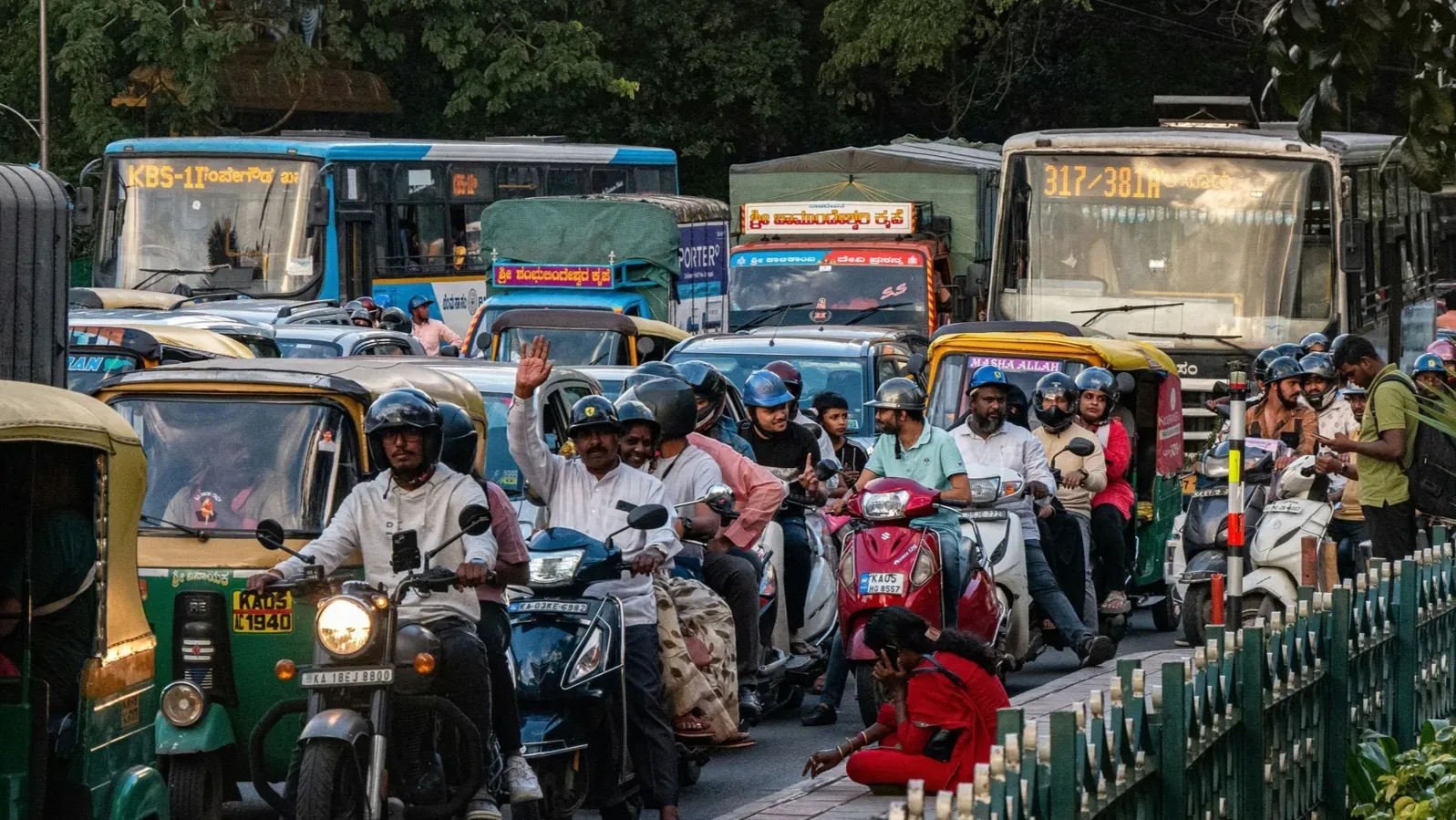
The NHTS is the first all-India survey focused on household travel. (Photo by Lukas Kienzler on Unsplash)
Workers commuting to fixed workplaces in India spend an average ₹785 per month, according to the country's first-ever National Household Travel Survey.
The average monthly expenditure on commuting to a fixed workplace stood at ₹1,044 per worker in urban areas, compared with ₹612 in rural India, the survey conducted by the National Statistics Office (NSO) showed.
Male workers spent an average ₹835 per month on fixed-workplace commutes, against ₹533 for female workers.
| Worker category | Average monthly commute spend |
|---|---|
| All workers | ₹785 |
| Rural workers | ₹612 |
| Urban workers | ₹1,044 |
| Male workers | ₹835 |
| Female workers | ₹533 |
The National Household Travel Survey (NHTS), conducted during July 2025-June 2026, covered 4,92,023 households and 20,34,371 persons across 14,274 villages and 10,377 urban blocks.
The survey defines travel as a trip covering more than one kilometre.
“The primary objective of the survey is to generate robust, data-driven insights into domestic travel patterns and dynamics to support regional transport planning, infrastructure development and evidence-based policy formulation,” the NSO said.
Two-wheelers emerged as the most commonly used mode of transport for workers travelling to fixed or non-fixed workplaces, accounting for 42.6% of such commutes nationwide.
Their share was considerably higher in urban areas at 52.3%, compared with 37.1% in rural areas.
Walking accounted for 28.3% of work commutes, followed by bicycles at 10.7%, buses at 6.7% and auto-rickshaws at 6.4%.
| Mode of transport | Rural workers | Urban workers | All workers |
|---|---|---|---|
| Two-wheeler | 37.1% | 52.3% | 42.6% |
| Walking | 36.6% | 13.5% | 28.3% |
| Bicycle | 13.4% | 5.8% | 10.7% |
| Auto-rickshaw | 5.0% | 8.8% | 6.4% |
| Bus | 5.3% | 9.2% | 6.7% |
| Train/Monorail/Tram | 0.4% | 5.0% | 2.1% |
| Car | 1.5% | 5.7% | 3.0% |
The survey found that 57.6% of workers aged 15 years and above undertook within-travel-day trips of more than one kilometre to fixed or non-fixed workplaces.
The proportion was higher in urban areas at 64.1%, compared with 54.5% in rural India.
The survey also showed a noticeable gender gap in work-related travel.
While 61.9% of male workers undertook such trips, the proportion was 41.9% among female workers.
The average journey time for those travelling to fixed workplaces was 25 minutes.
The survey found that 83.4% of workers reached their fixed workplace within 30 minutes. The share was 86.1% in rural areas and 79.3% in urban areas.
| Commute duration | Rural | Urban | All workers |
|---|---|---|---|
| Up to 30 minutes | 86.1% | 79.3% | 83.4% |
| 30–60 minutes | 11.8% | 16.6% | 13.7% |
| 60–90 minutes | 1.4% | 3.0% | 2.0% |
The findings also showed that buses and inter-city railways together accounted for 73.5% of overnight household travel, with buses alone accounting for 55.8% and railways 17.7%.
Social and religious activities accounted for 70.2% of overnight household trips, while culture, leisure, sports and tourism made up 7.4%.
The NHTS is the first all-India survey focused on household travel and is intended to provide a benchmark for understanding travel behaviour across rural and urban India.
About The Author
Next Story

