
Business News
India, Belgium agree to deepen ties in defence, critical minerals; target doubling trade in 5 years
4 min read | Updated on September 03, 2026, 15:16 IST


SUMMARY
India and Belgium agreed to expand military exchanges, training, intelligence sharing and defence cooperation, including opportunities for defence co-development and co-production.
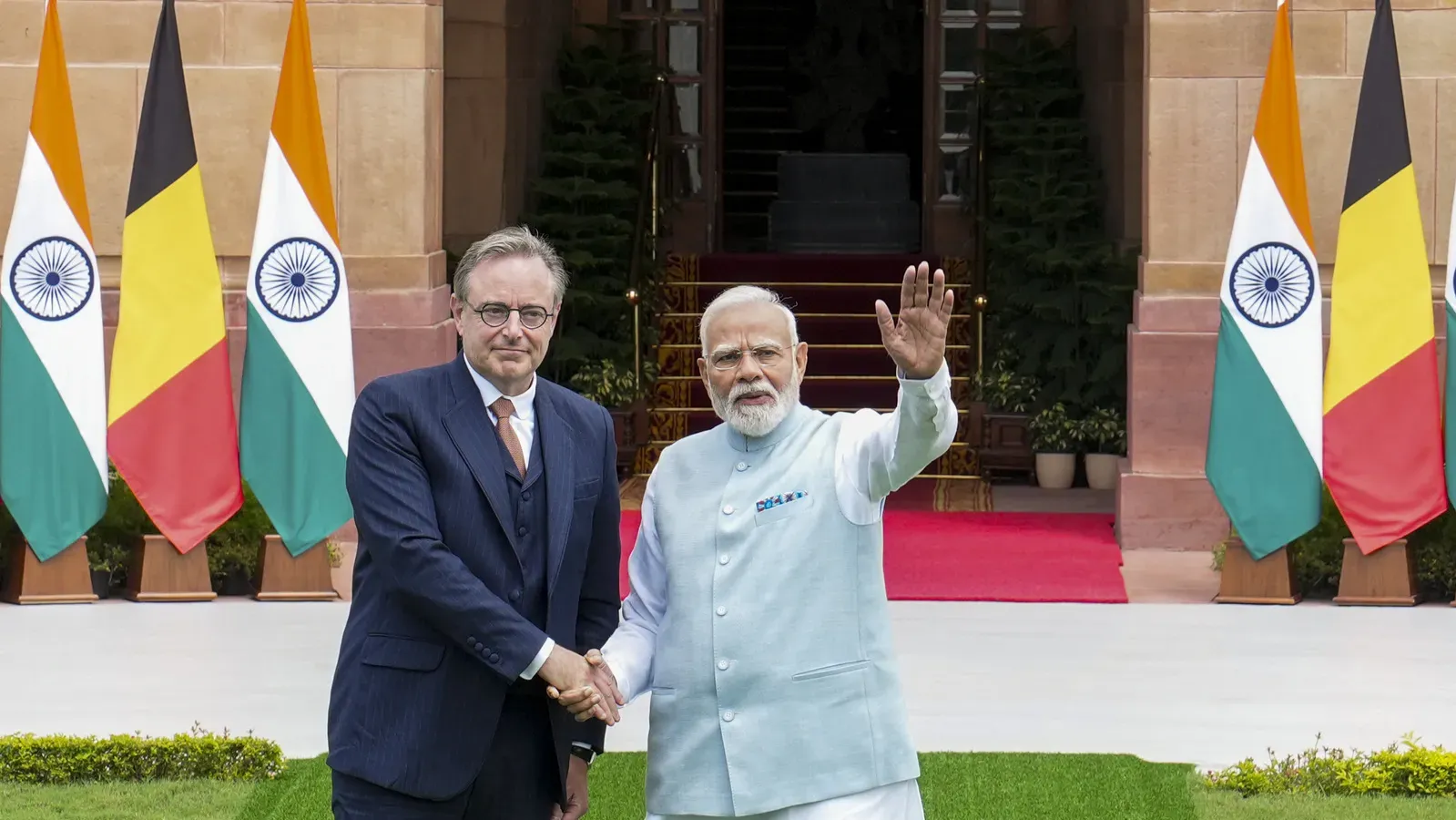
Prime Minister Narendra Modi exchanges a handshake with his Belgian counterpart Bart De Wever before a bilateral meeting, at Hyderabad House in New Delhi, Thursday, Sept. 3, 2026. (PTI Photo)
Prime Minister Narendra Modi and his Belgian counterpart Bart De Wever on Thursday held wide-ranging talks on strengthening bilateral cooperation in trade, defence, clean energy, critical minerals, semiconductors and mobility.
Addressing a joint press conference after the talks, PM Modi said India and Belgium had agreed to enhance military exchanges and training.
He also said that agreements between the governments and defence industries would open up opportunities for defence co-development and co-production.
"Defence and security cooperation is a key pillar of our relationship," Modi said.
He said the two countries would also strengthen intelligence sharing and cooperation against crime between their respective agencies.
Modi said India and Belgium were working together on modern defence equipment such as the Zorawar tank.
In Kakinada, Andhra Pradesh, the two countries are developing one of the world's largest green ammonia projects, he said.
India has established an "Investment Fast-Track Mechanism" for Belgian companies and decided to make the India-Belgium Business Forum a regular mechanism, he said.
"We will enhance synergy between the financial, fintech, and regulatory institutions of both nations, and through these measures, we will realise the goal of doubling bilateral trade over the next five years," Modi said.
He said the two sides had also decided to enhance cooperation in processing and recycling critical minerals.
"Belgium's expertise in semiconductors and India's scale complement each other; in this regard, we will work together to integrate Belgium's IMEC Institute with India's semiconductor ecosystem," Modi said.
The two countries also agreed to strengthen links between their startups, enhance capacity building in the maritime sector and deepen cooperation in universities and research.
Modi said India and Belgium would soon sign a Migration and Mobility Partnership Agreement to facilitate the movement of talent.
De Wever, who is on a three-day visit to India, said it was particularly meaningful for him to be the first Belgian prime minister to visit India in 20 years.
"That's a very long time. It's too long," he said.
He said India had changed enormously over the past two decades, particularly during Modi's tenure, and described it as not only the world's largest democracy but also the fastest-growing major economy, an economic and technological powerhouse and a major geopolitical factor.
"For Belgium, this makes India an increasingly important partner, and I believe my country also has a lot to offer to India in return," De Wever said.
The Belgian prime minister also referred to the two countries' shared history, recalling the role of Indian soldiers who fought and died in Flanders during the First World War.
In a lighter moment, De Wever said he had planned to present Modi with a sculpture of India Gate made entirely of Belgian chocolates.
"But unlike the real India Gate, which has stood for almost a century, the chocolate version didn't even survive the journey to India," he said.
"Chocolate is excellent for diplomacy, but not excellent for diplomatic travel," he added, saying a backup version remained in Belgium and that he would find a way to deliver it to Modi intact.
De Wever said the exchange of a Letter of Intent had provided a new framework for cooperation ranging from government-to-government contacts and military exchanges to research, innovation, co-development and, hopefully, co-production.
He said additional defence-related memoranda of understanding were also being concluded during the visit of Belgian Defence Minister Theo Francken, bringing companies and institutions from both countries closer together.
"Security, too, is something we strengthen by working with partners we can trust," De Wever said.
Belgium was among the first European countries to establish diplomatic relations with independent India in September 1947.
The European country is an important economic partner for India, with bilateral trade reaching $13.01 billion in 2025-26. Diamond trade, with Antwerp serving as a major global diamond hub, remains an important component of bilateral commerce.
Belgium is also an important source of investment in India, with foreign direct investment inflows from the country amounting to around $4.2 billion between April 2000 and December 2025.
About The Author
Next Story

