Authentication
Upstox uses the standard OAuth 2.0 authorization code flow to log customers in and issue access tokens. Your application never handles Upstox credentials directly — the customer signs in on Upstox, and your app receives an access token to call the API on their behalf.
In short: your app sends the customer to Upstox, the customer logs in, Upstox returns a single-use authorization code, your server exchanges that code for an access_token, and your app uses the token to call the API. The steps below walk through each stage.
All logins are handled by upstox.com. There is no public endpoint for other applications to directly log the customer into their upstox.com. For security and compliance purposes, all logins and logouts are handled exclusively by upstox.com.
Before you begin
To complete the flow, create an app on Upstox Developer Apps. From it you will need:
- The API key (
client_id) and API secret (client_secret). - A registered redirect URI that exactly matches the one you send in Step 1.
In OAuth, client_id is your API Key (not the customer's UCC) and client_secret is your API Secret.
Step 1: Redirect the customer to the Upstox login
Open the Upstox login page in a Webview (or similar) and pass the parameters below as query parameters:
https://api.upstox.com/v2/login/authorization/dialog
| Parameter | Required | Description |
|---|---|---|
client_id | Yes | The API key obtained during the app generation process. |
redirect_uri | Yes | The URL the customer is redirected to after authentication. Must match the URL registered during app generation. |
response_type | Yes | Must always be code. |
state | No | Returned unchanged after authentication, letting you maintain state continuity between the request and the callback. |
URL construction:
https://api.upstox.com/v2/login/authorization/dialog?response_type=code&client_id=<Your-API-Key-Here>&redirect_uri=<Your-Redirect-URI-Here>&state=<Your-Optional-State-Parameter-Here>
Sample URL:
https://api.upstox.com/v2/login/authorization/dialog?response_type=code&client_id=615b1297-d443-3b39-ba19-1927fbcdddc7&redirect_uri=https%3A%2F%2Fwww.trading.tech%2Flogin%2Fupstox-v2&state=RnJpIERlYyAxNiAyMDIyIDE1OjU4OjUxIEdNVCswNTMwIChJbmRpYSBTdGFuZGFyZCBUaW1lKQ%3D%3D
- Redirect URLs ending in
.phpor similar extensions may be blocked for security reasons. Avoid placing the redirect at the end of the URL — position it somewhere in the middle instead. - An
Invalid Credentialserror usually means the request parameters (client_id,redirect_uri, andresponse_type) do not match the values registered during app creation. Verify these and correct any discrepancies before retrying.
The customer is then taken to the Upstox login page to sign in.
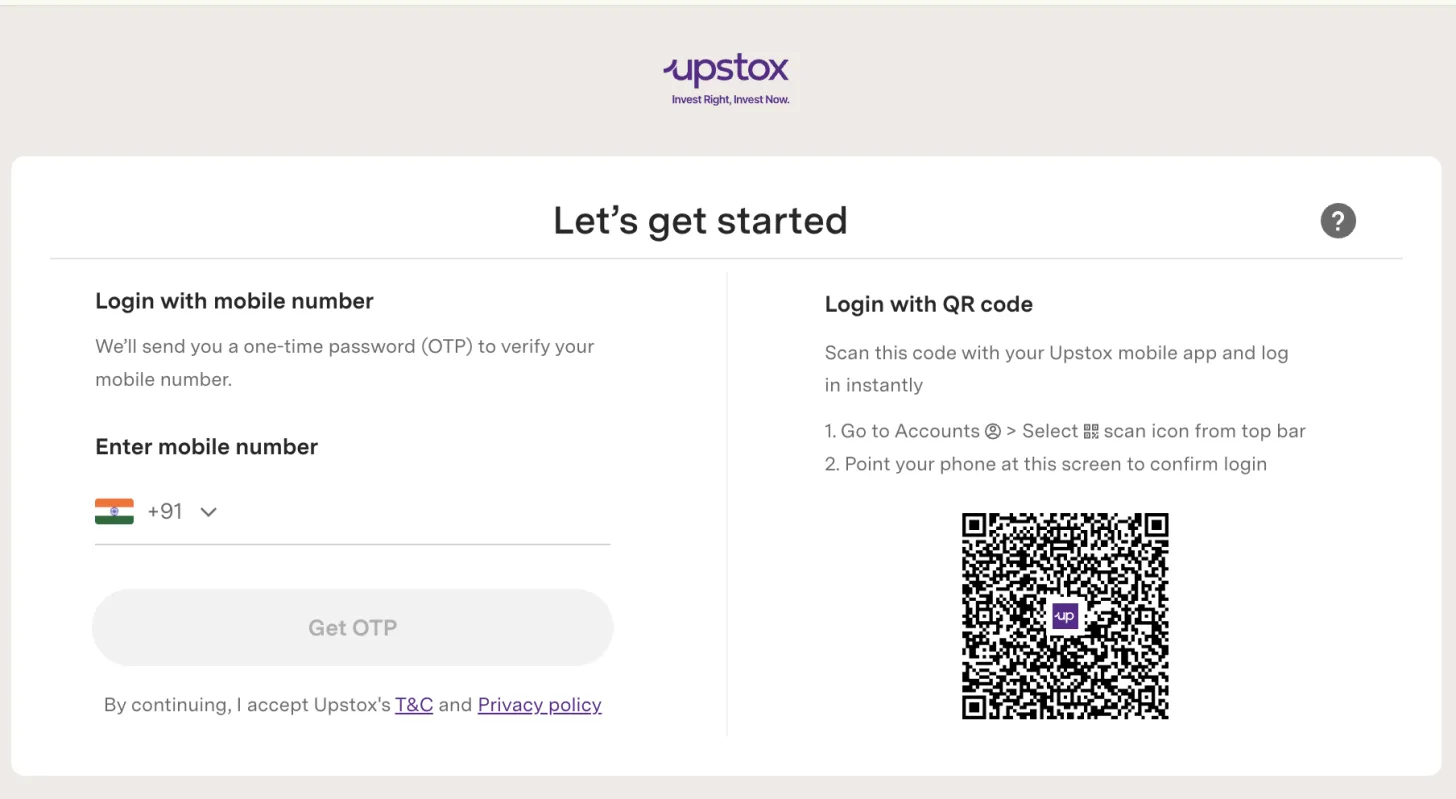
Customers can choose TOTP (Time-based One-Time Password) instead of SMS OTP for 2FA — a more secure method for a safer login. Learn how to activate TOTP on an Upstox account here.
Step 2: Receive the authorization code
After a successful login, Upstox redirects to the redirect_uri you provided, with the code needed for token generation included as a query parameter:
https://<redirect_uri>?code=mk404x&state=XX56849
| Parameter | Description |
|---|---|
code | Use this to generate the access_token in the next step. |
state | Returned only if it was included in the original request URL. |
Step 3: Exchange the code for an access token
Make a server-to-server POST call from your backend to exchange the authorization code for an access_token:
https://api.upstox.com/v2/login/authorization/token
The authorization code is valid for a single use, regardless of whether the access token generation succeeds or fails.
Pass the following parameters:
| Parameter | Description |
|---|---|
code | The single-use code returned in Step 2 upon a successful Authorize API authentication. |
client_id | The API key obtained during the app generation process. |
client_secret | The API secret obtained during the app generation process. Keep it confidential — it is known only to your app and Upstox. |
redirect_uri | The URL provided during app generation. |
grant_type | Must always be authorization_code. |
- cURL
- Python
- Node.js
curl -X 'POST' 'https://api.upstox.com/v2/login/authorization/token' \
-H 'accept: application/json' \
-H 'Content-Type: application/x-www-form-urlencoded' \
-d 'code=<Your-Auth-Code-Here>&client_id=<Your-API-Key-Here>&client_secret=<Your-API-Secret-Here>&redirect_uri=<Your-Redirect-URI-Here>&grant_type=authorization_code'
import requests

url = "https://api.upstox.com/v2/login/authorization/token"
headers = {
    "accept": "application/json",
    "Content-Type": "application/x-www-form-urlencoded",
}
data = {
    "code": "<Your-Auth-Code-Here>",
    "client_id": "<Your-API-Key-Here>",
    "client_secret": "<Your-API-Secret-Here>",
    "redirect_uri": "<Your-Redirect-URI-Here>",
    "grant_type": "authorization_code",
}

response = requests.post(url, headers=headers, data=data)
print(response.json())
const url = "https://api.upstox.com/v2/login/authorization/token";

const params = new URLSearchParams({
  code: "<Your-Auth-Code-Here>",
  client_id: "<Your-API-Key-Here>",
  client_secret: "<Your-API-Secret-Here>",
  redirect_uri: "<Your-Redirect-URI-Here>",
  grant_type: "authorization_code",
});

const response = await fetch(url, {
  method: "POST",
  headers: {
    accept: "application/json",
    "Content-Type": "application/x-www-form-urlencoded",
  },
  body: params,
});

const data = await response.json();
console.log(data);
The response returns an access_token, which your front-end application can use to call the Upstox API on the customer's behalf.
Other ways to generate a token
The authorization code flow above is the standard, interactive method. Two alternatives are available for apps that cannot run an interactive login each time:
| Method | Best for | How a token is delivered |
|---|---|---|
| Authorization code flow (Steps 1–3 above) | Apps that log customers in interactively | Exchanged on your server from a single-use code |
| Semi-automated | Scheduled/automated apps that still require approval | Pushed to your notifier URL after manual approval |
| Manual | One-off or personal utilities | Copied from the developer dashboard |
Semi-automated token generation
For apps that automate authentication requests but require manual approval:
- Configure your app to trigger the auth request at a specific time, as detailed in the Access Token Request API.
- When notified on your mobile, approve the authentication by either:
- Clicking the link in the notification, or
- Visiting Upstox Developer Apps and approving the request.
- Once approved, the access token is delivered to the notifier URL set during app creation.
- Ensure your app listens on the notifier URL and stores the token for further use.
For more details on implementation and usage, see the Access Token Request Documentation.
Manual token generation
If your app is a small utility where manual input is feasible, you can generate an access token directly:
- Visit Upstox Developer Apps and click the app you created.
- Click Generate to create a new access token.
- Copy the generated token and use it in your app.
This is ideal for one-time or occasional API usage where automation isn't required.